DMBOK area 1
Data governance
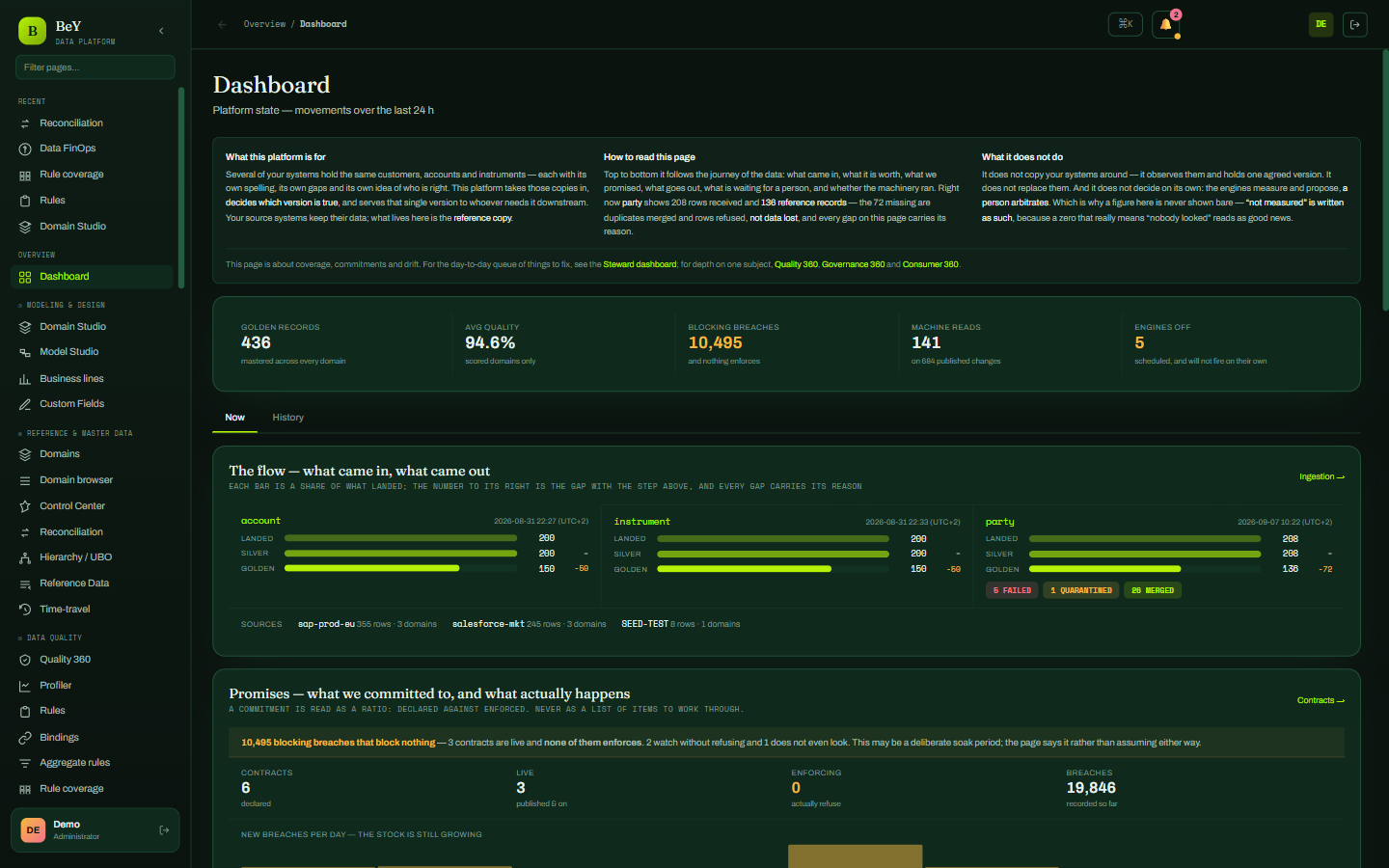
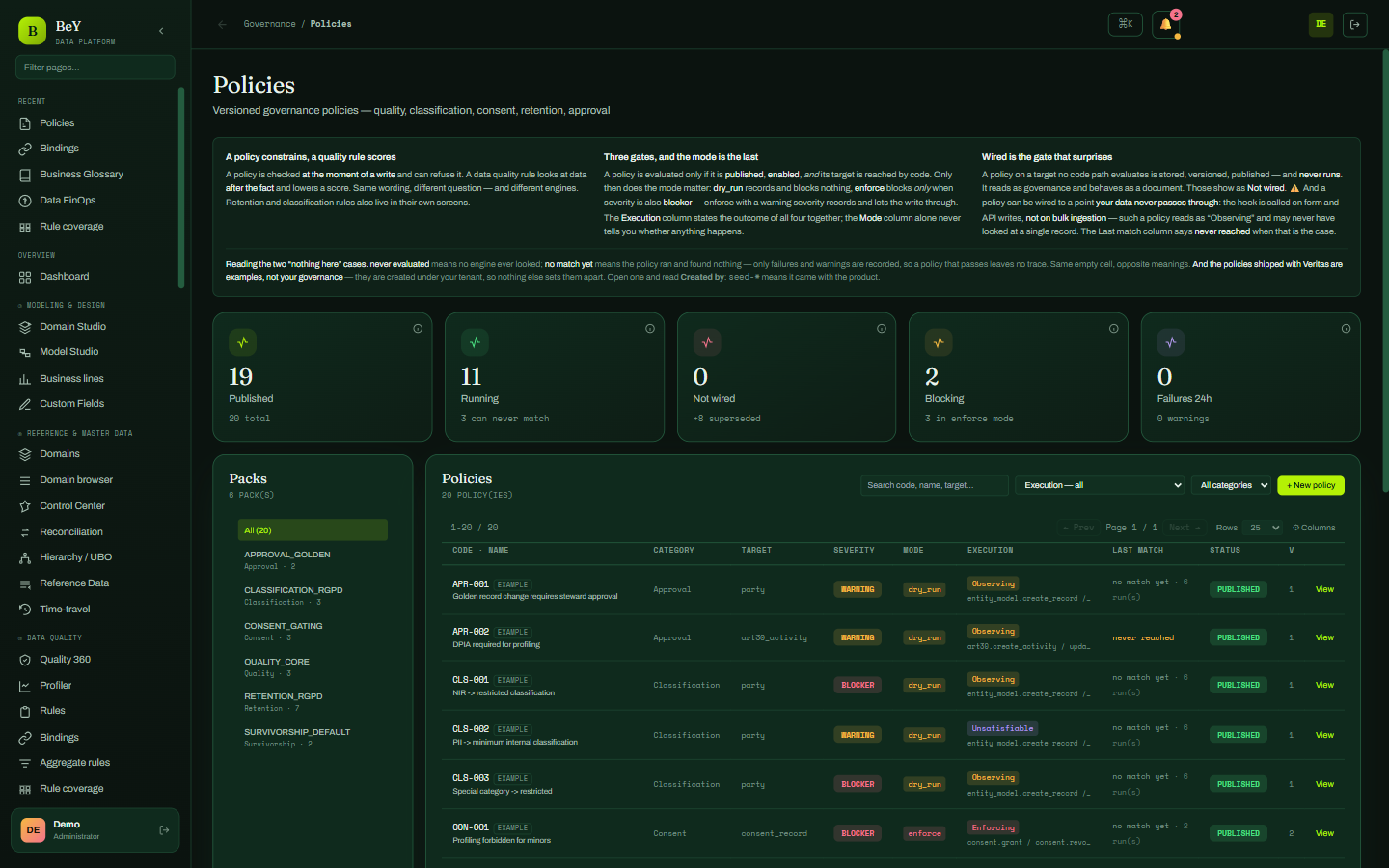
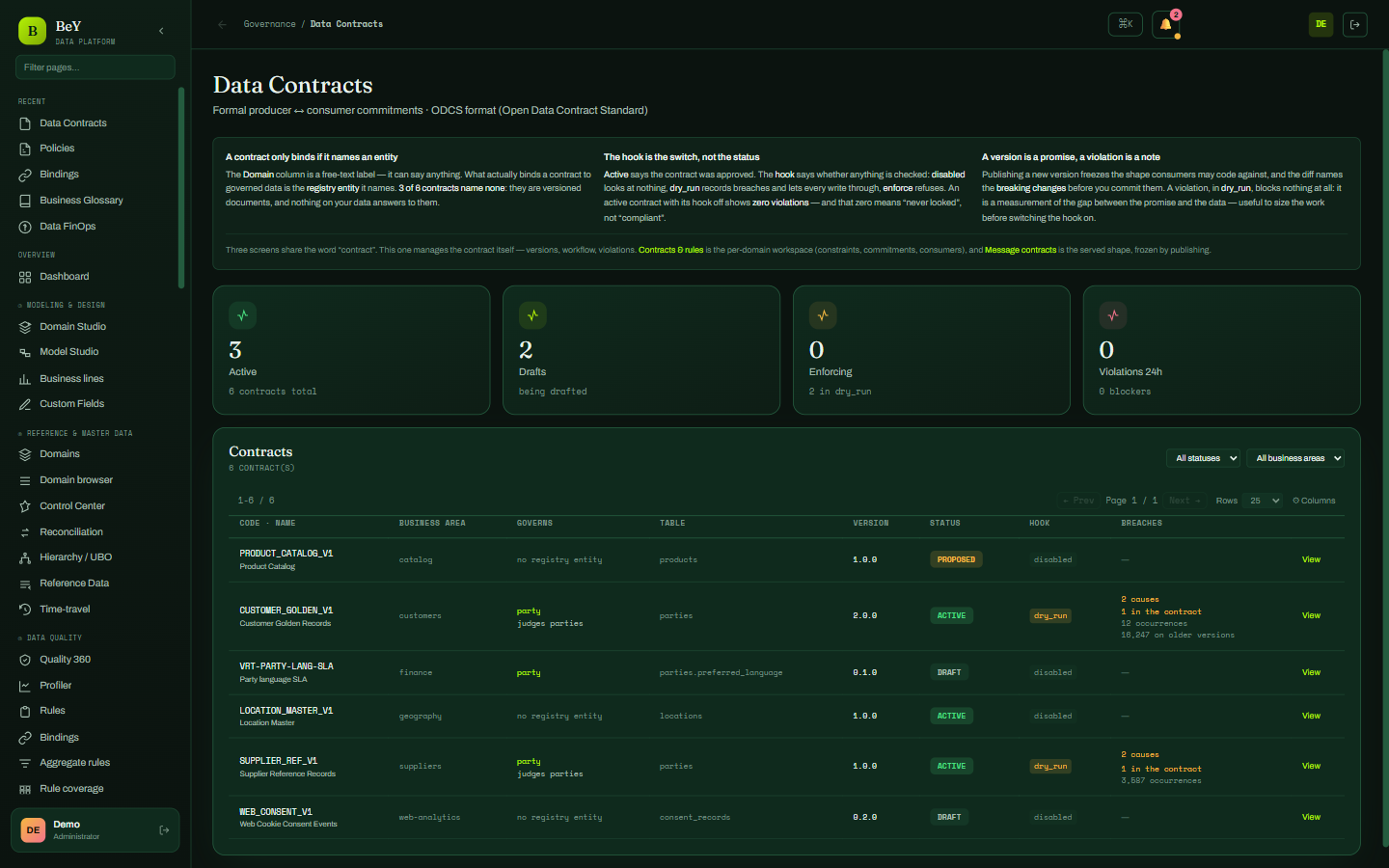
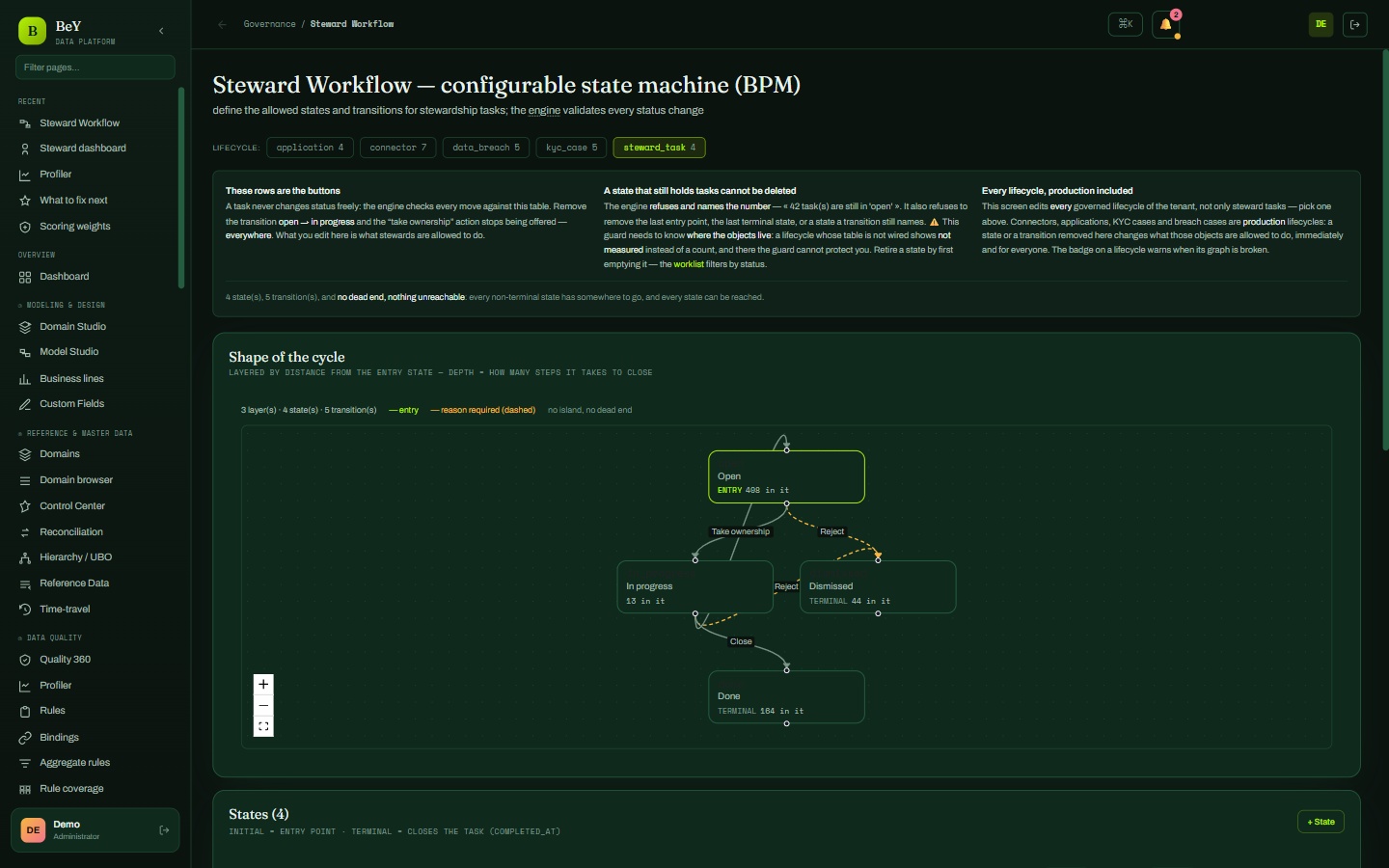
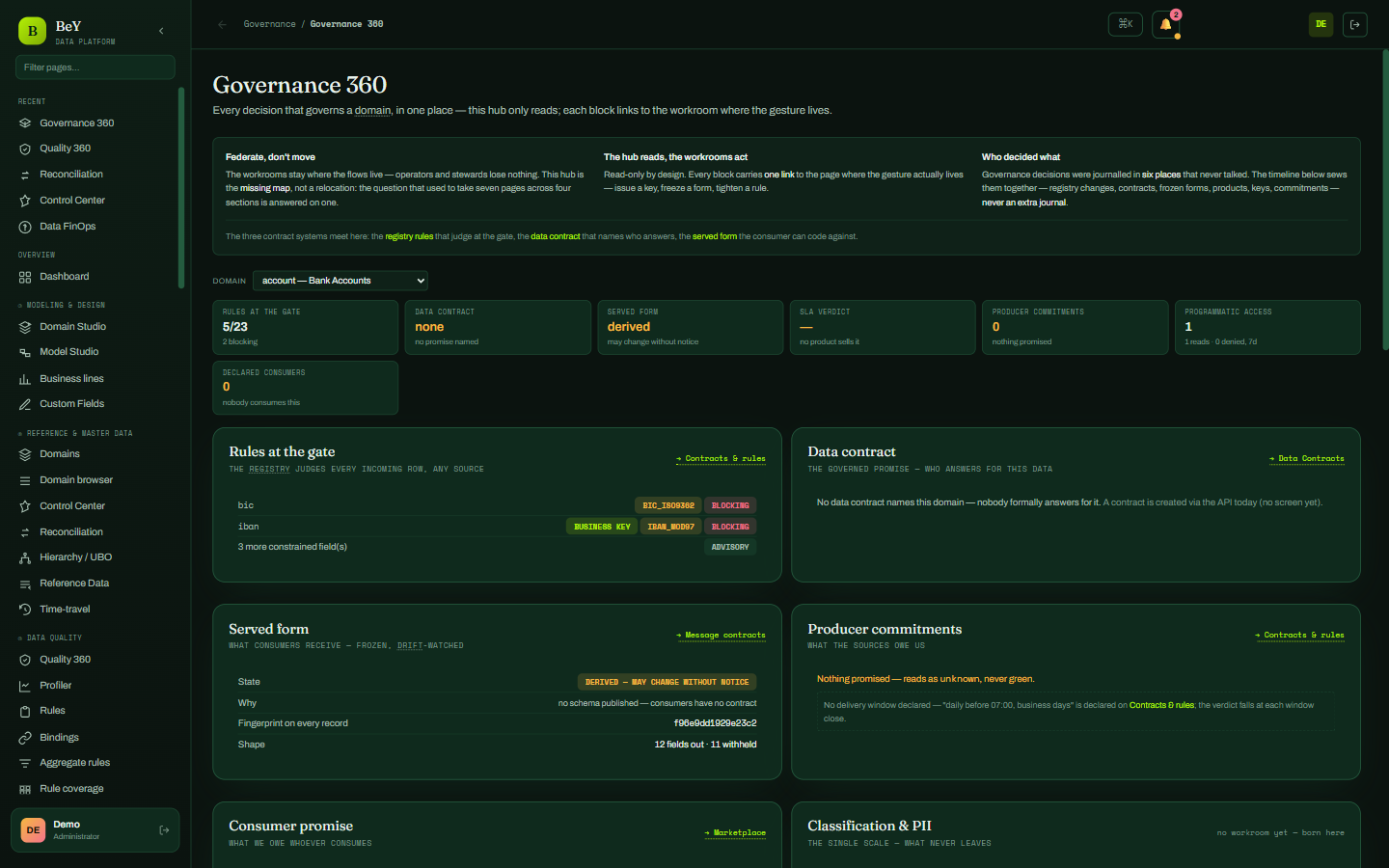
Policies you can run, not just file. Who owns each domain, who fixes what breaks, and contracts that catch a schema change before the consumer does.
Master data · Quality · Governance · AI
BeY builds one golden record per entity, keeps the provenance of every field, and measures quality where the data lives. An AI assistant on Amazon Bedrock explains what it finds, ranks what to fix and drafts the fix — a person confirms it.
Capabilities
The split follows the DMBOK2 knowledge areas — the reference framework for data management. Eight of the eleven have their own screens today. Data architecture lives inside modeling and design, and the last two — document management, and the data warehouse and BI — are under construction.
DMBOK area 1
Policies you can run, not just file. Who owns each domain, who fixes what breaks, and contracts that catch a schema change before the consumer does.
DMBOK area 3
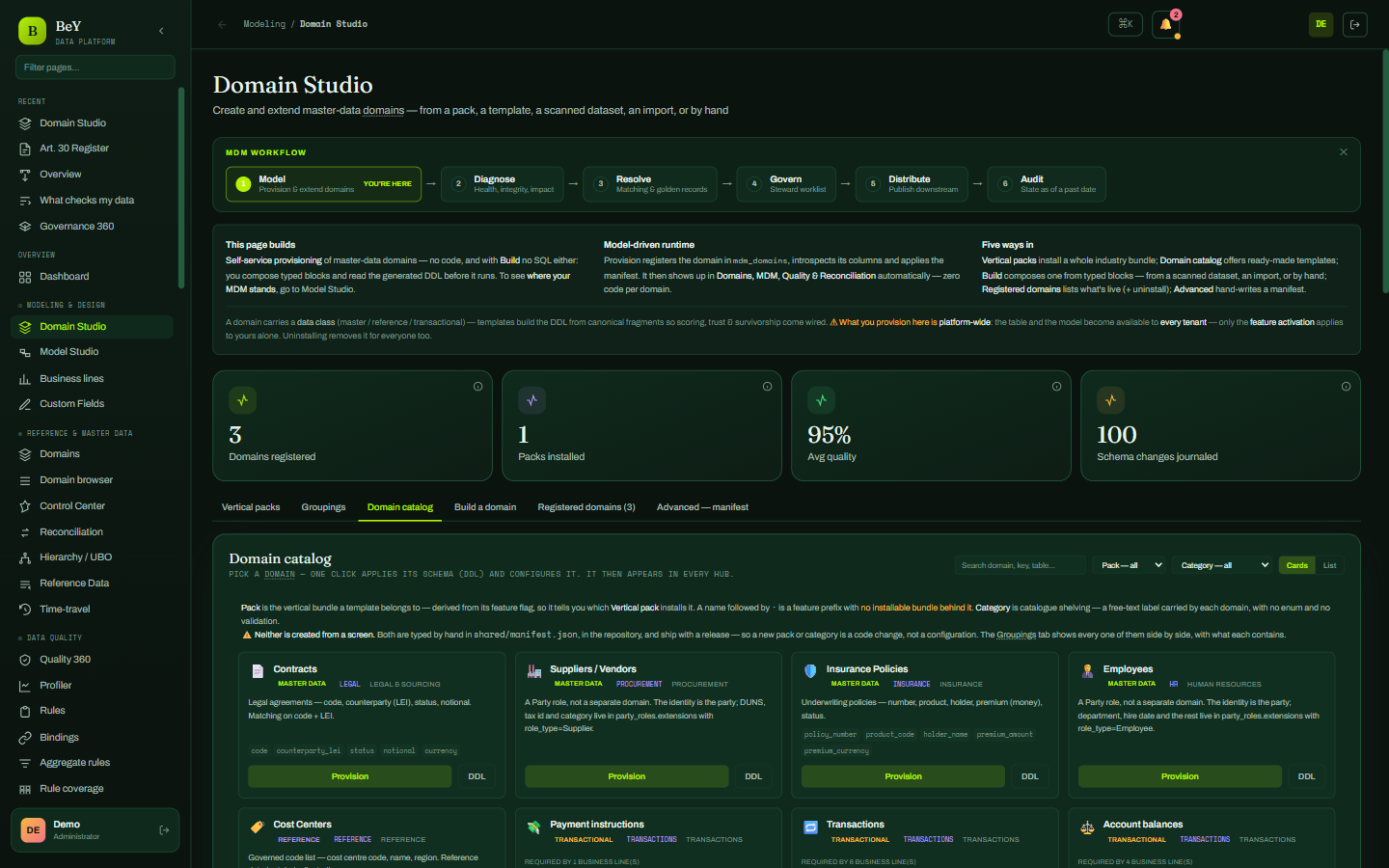
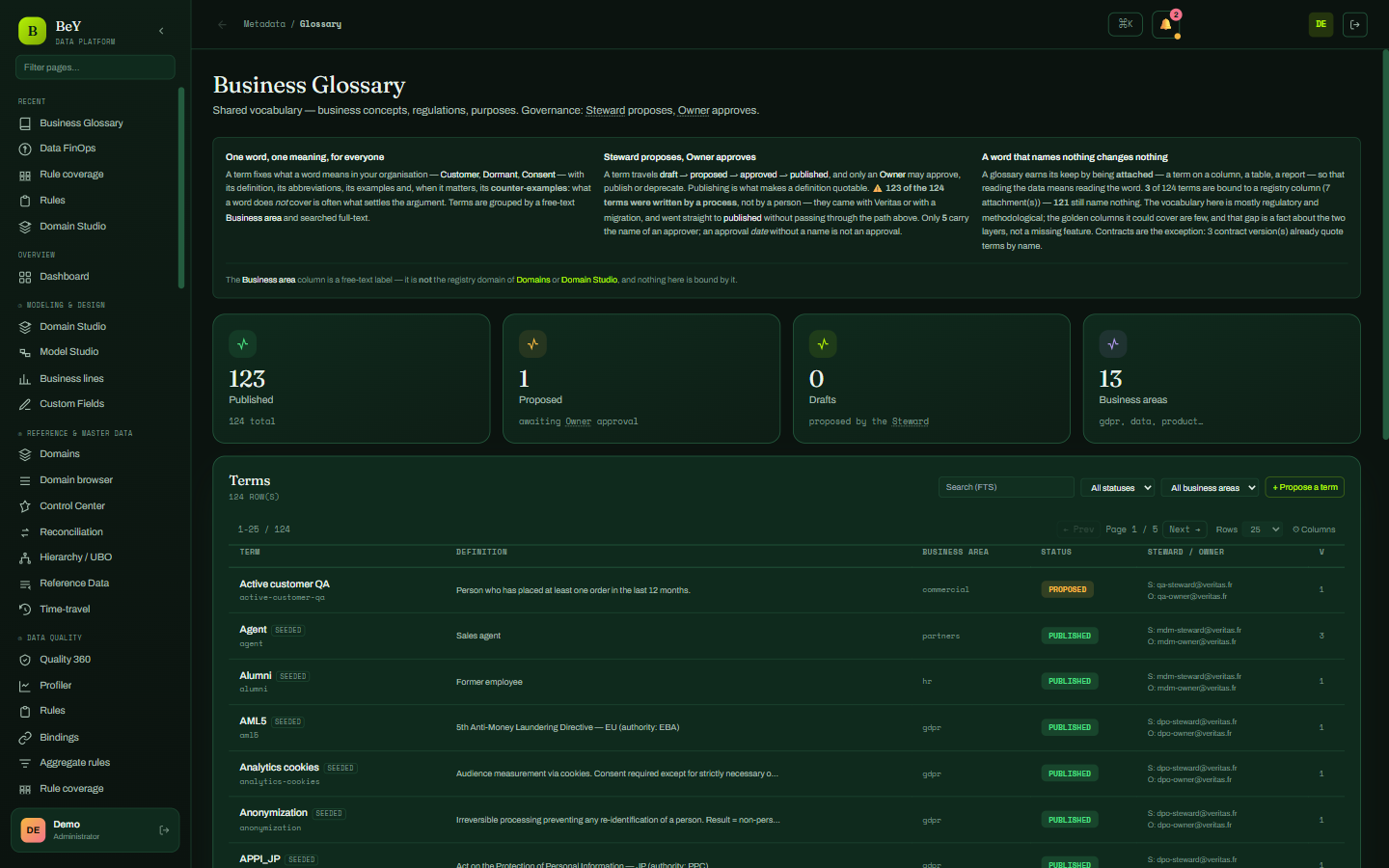
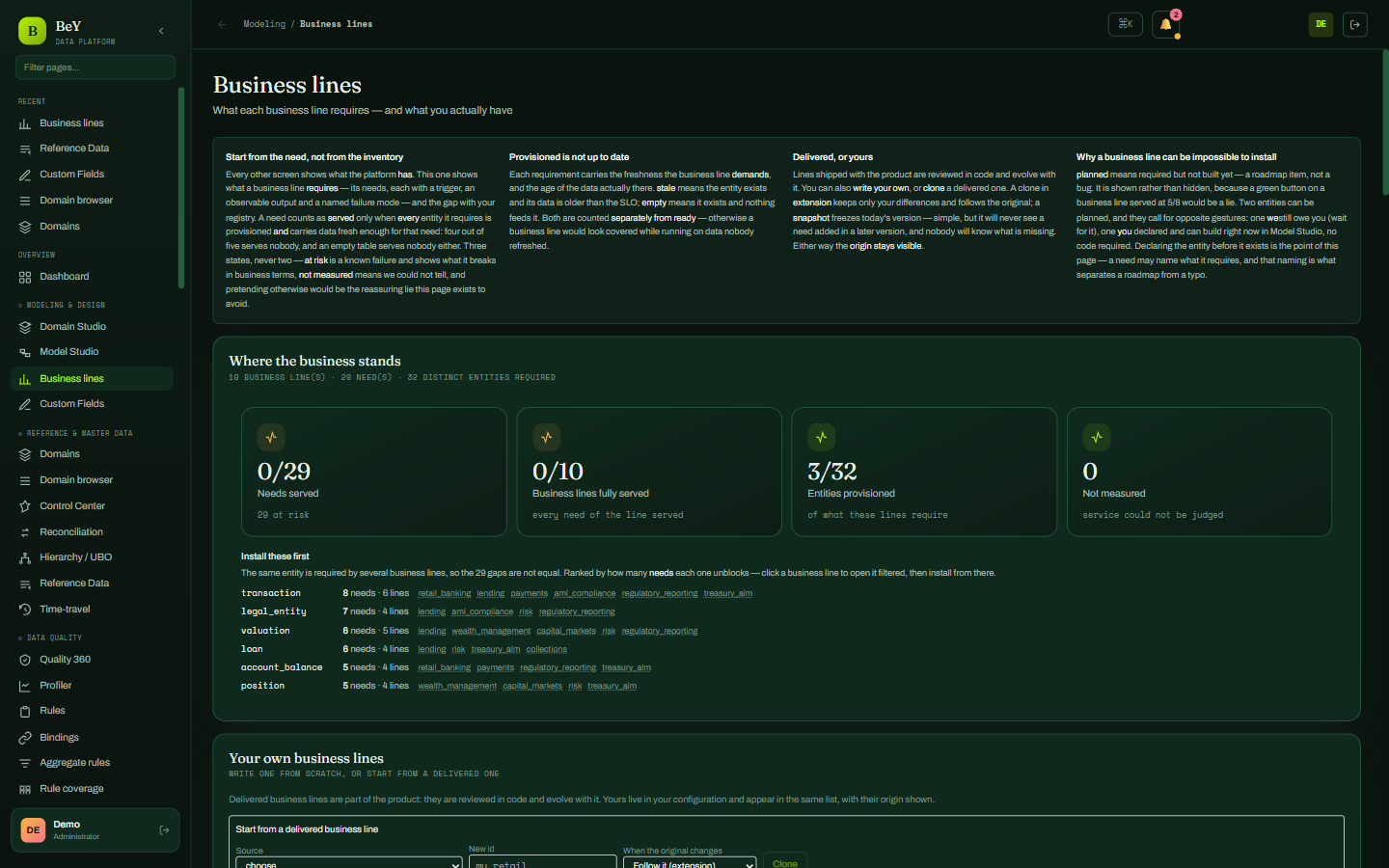
Get the model right before anything else. Business lines, domains and entities described without code — because the matching engine can only find the duplicates the model lets it see.
DMBOK area 4
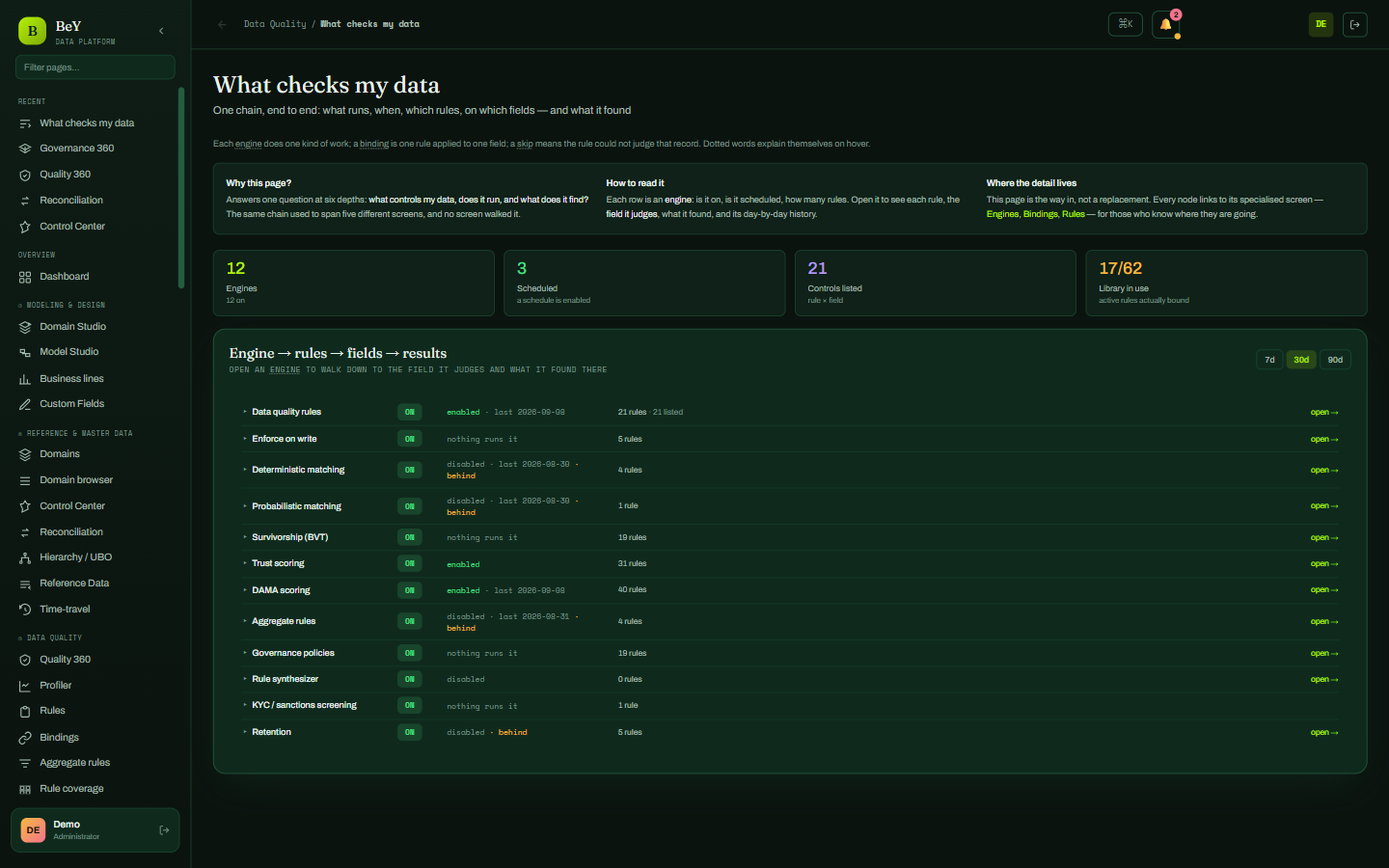
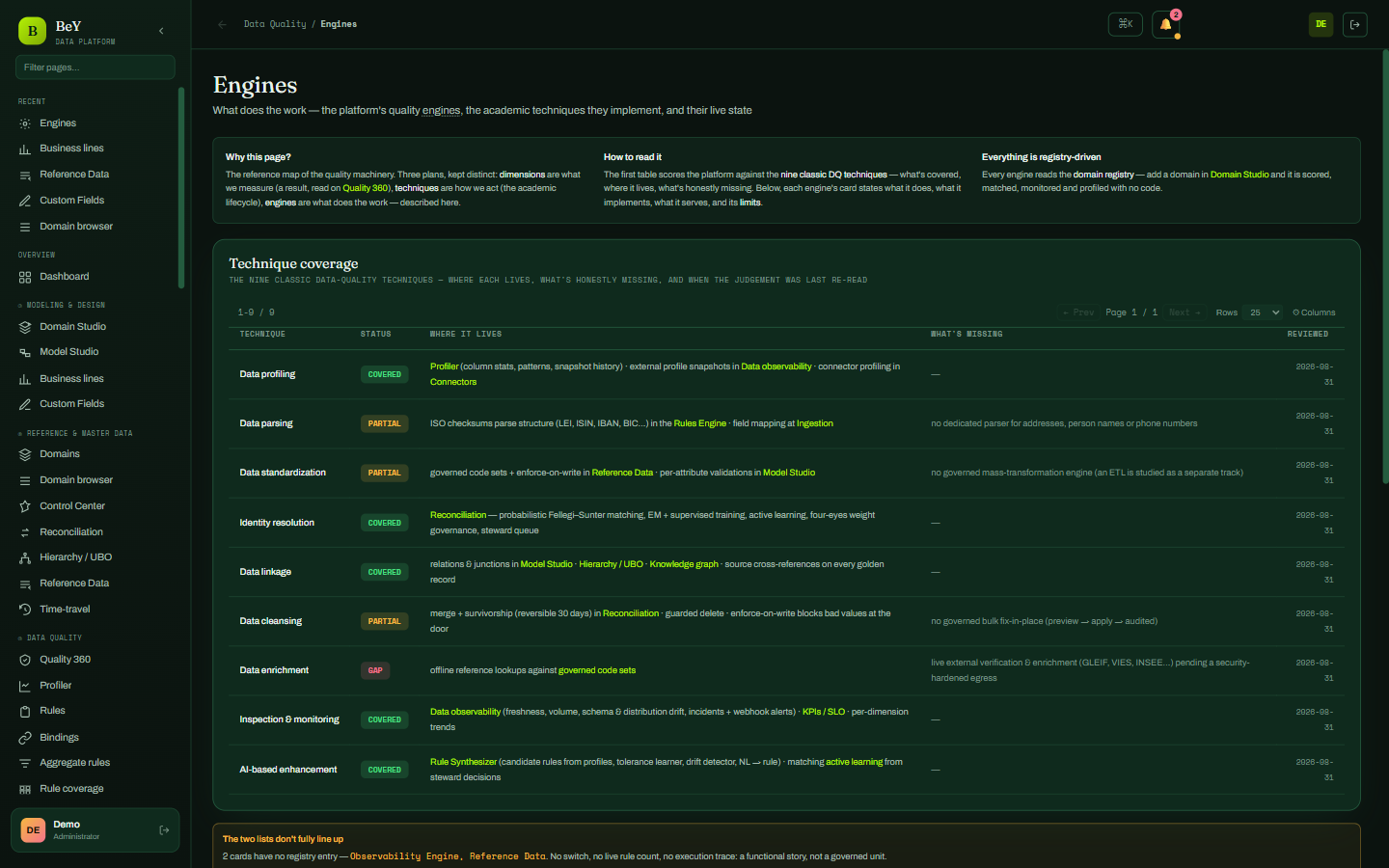
A control that ran is worth more than a control that exists. Every engine reports whether it is on, how many rules feed it and when it last fired — next to the AWS bill and the tenant's own settings.
DMBOK area 5
GDPR held by the platform, not by a spreadsheet. The Article 30 register is built from the data model, so it cannot drift from what you actually process — and every retention rule leaves proof that the purge ran.
DMBOK area 6
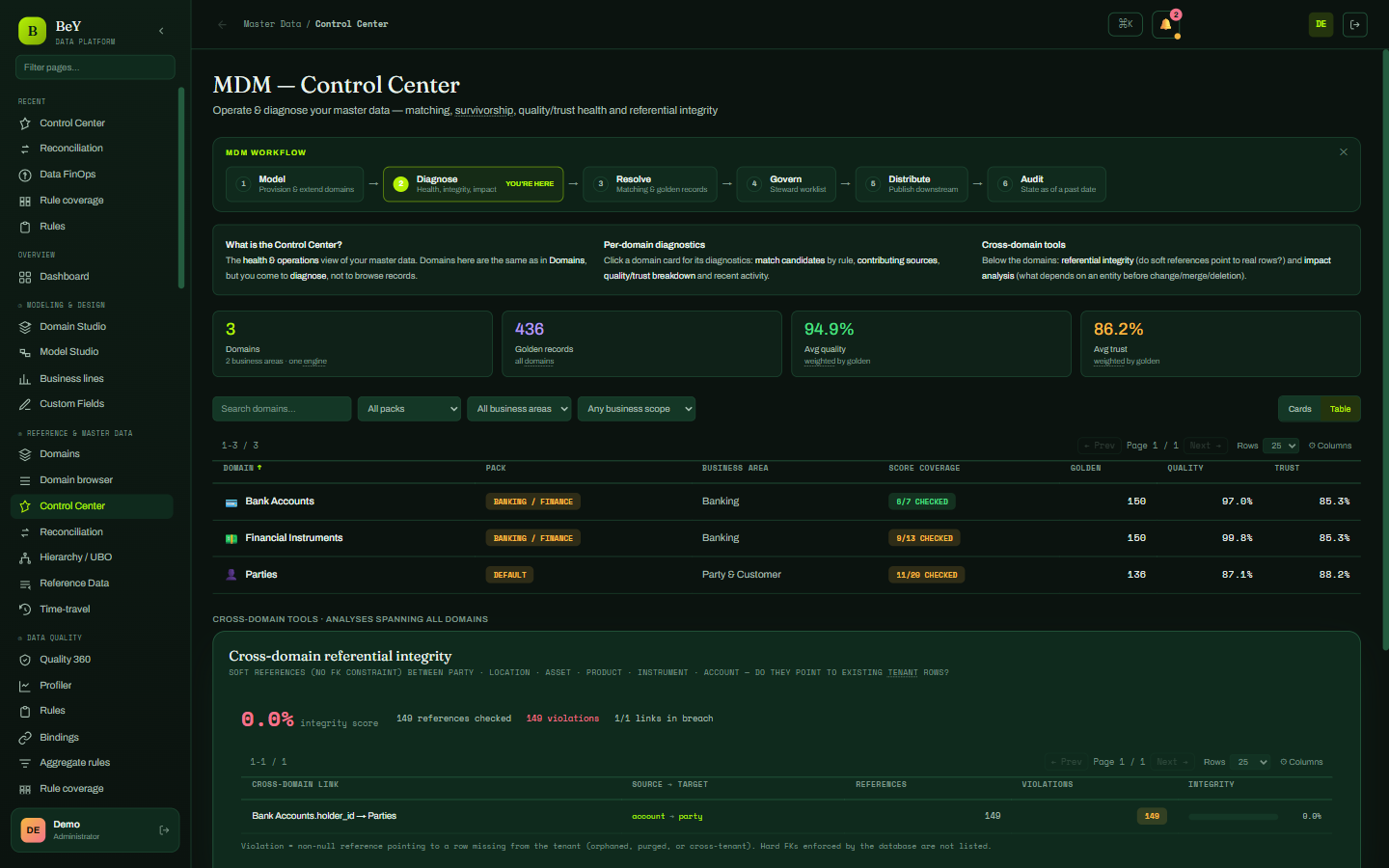
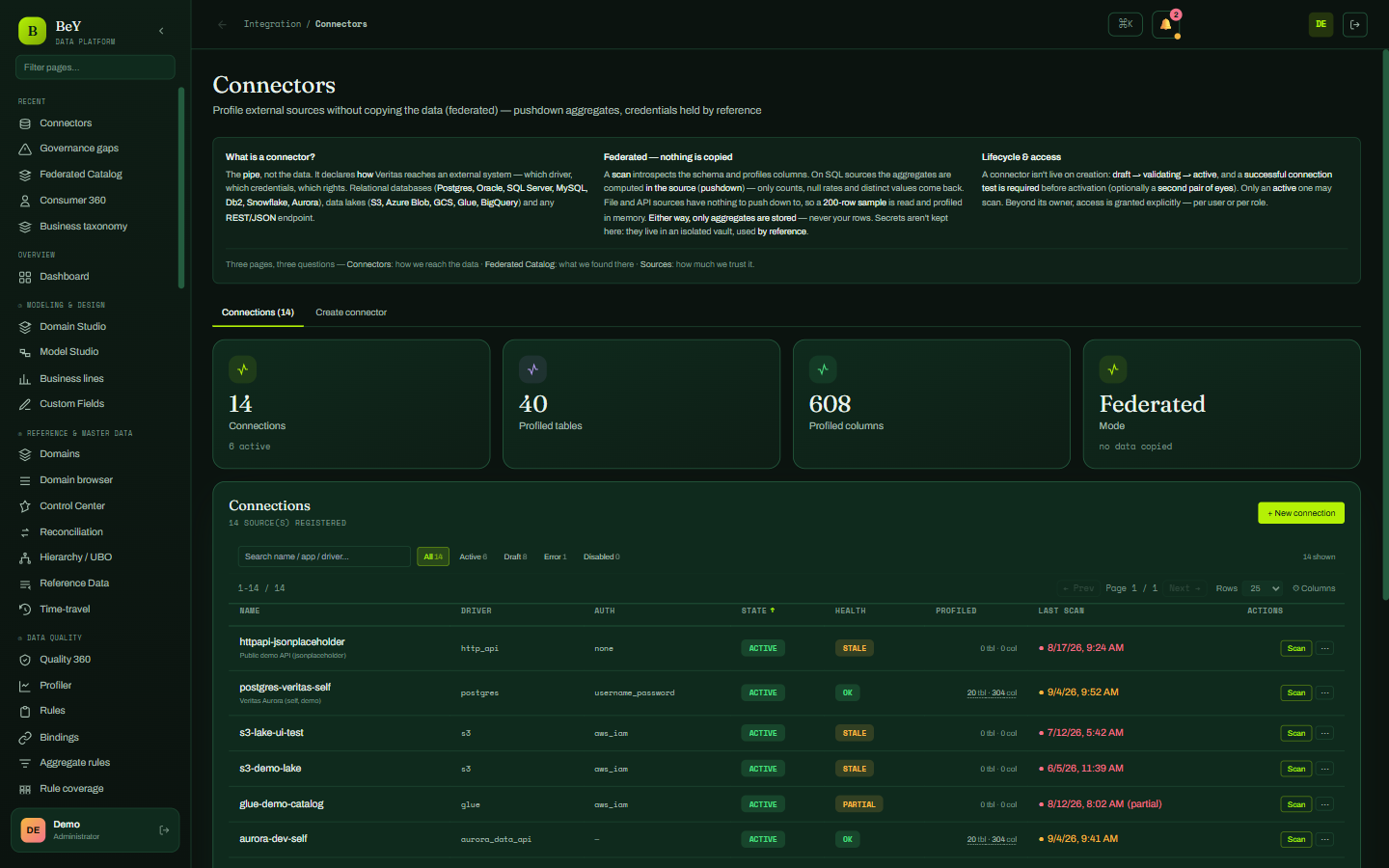
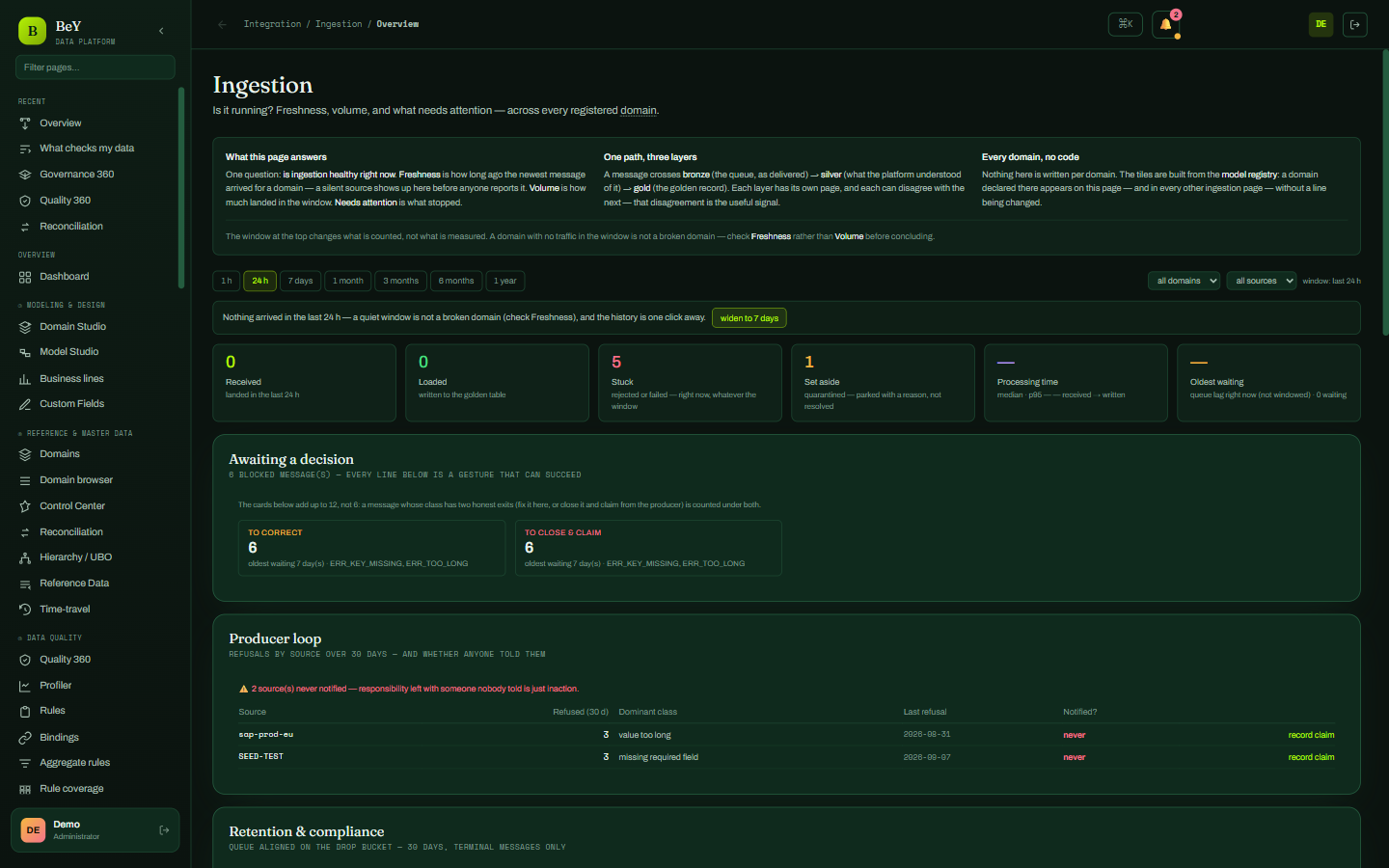
Nothing gets in without a contract, nothing gets out without a policy. Rejected rows land in quarantine with their cause attached; published data is filtered for whoever asks, and counted.
DMBOK area 8
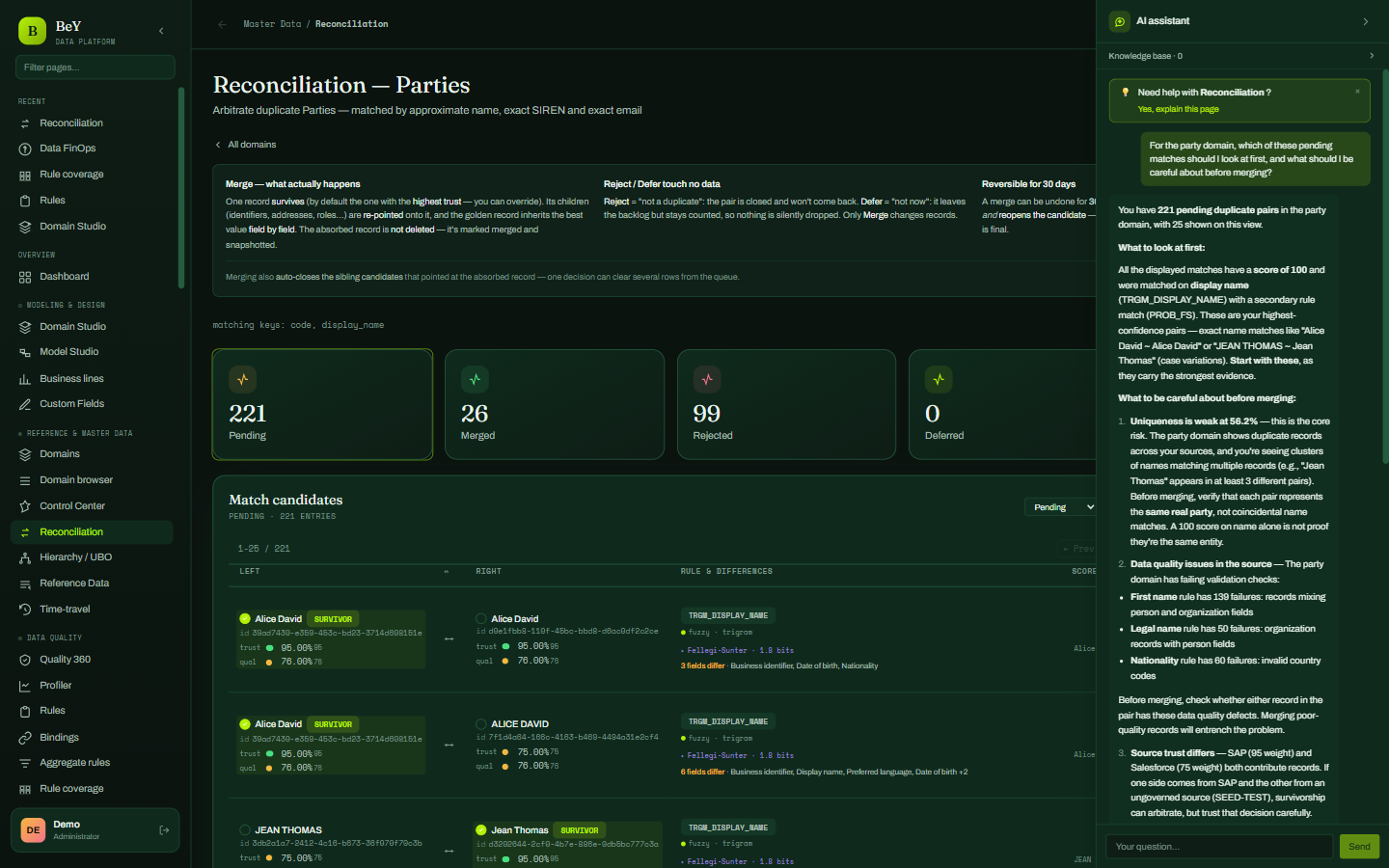
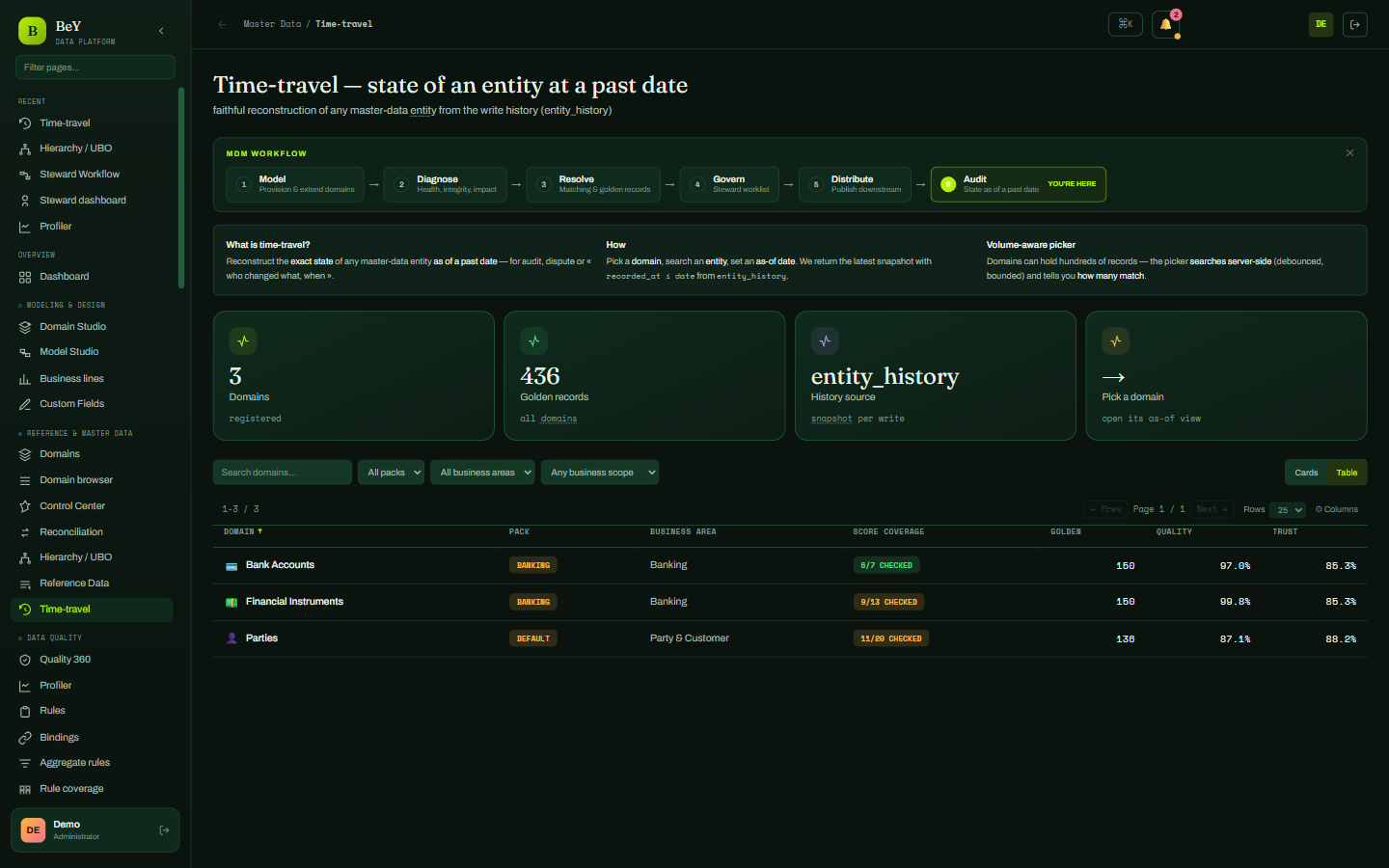
The golden record, and the proof behind every field. Each value keeps its source, the rule that chose it and who arbitrated — so a merge can be undone for thirty days without loss, and any record replayed as it stood on any date.
DMBOK area 10
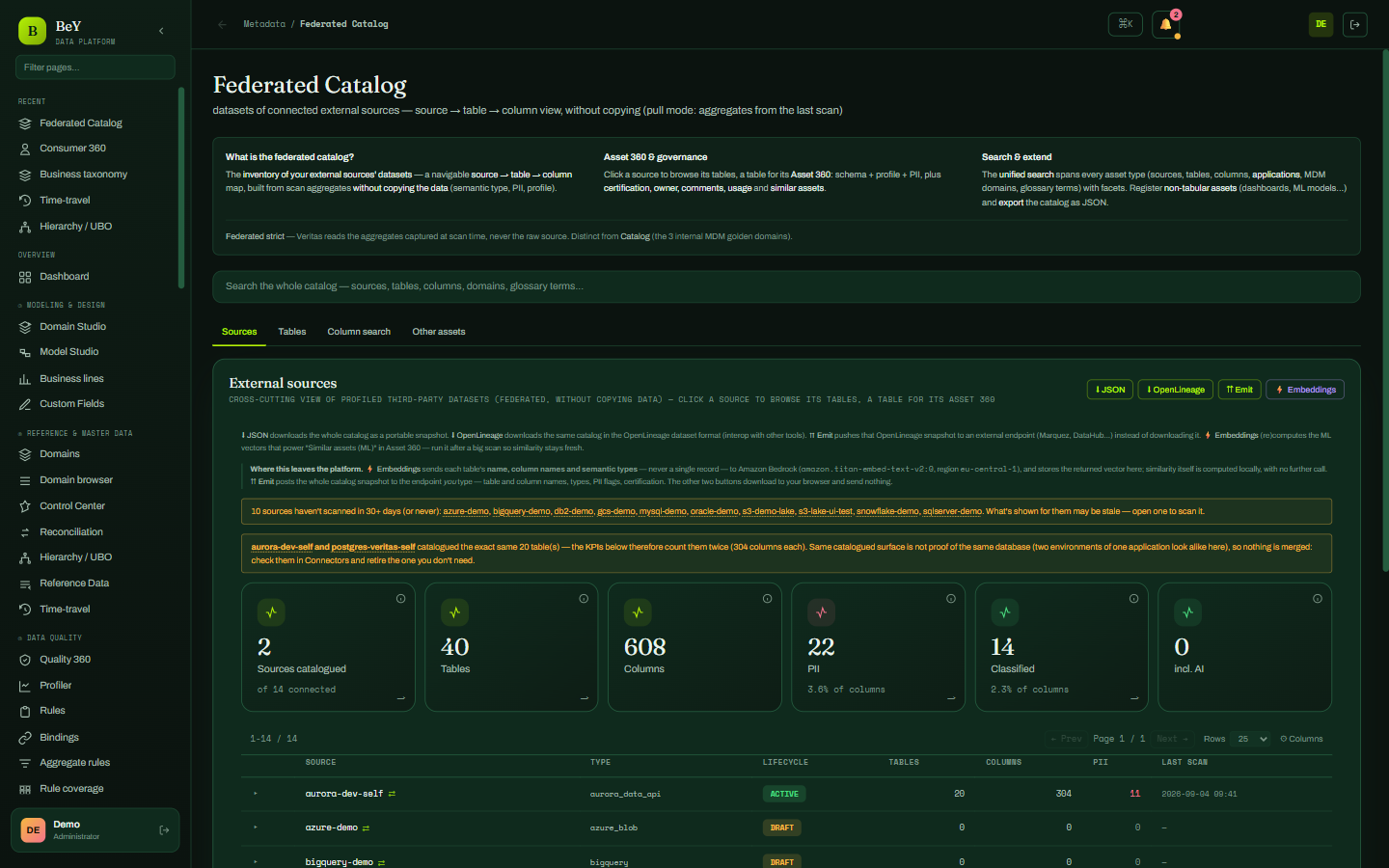
Business terms bound to real columns, not to a wiki. And lineage that draws what the platform observed and what people declared in different strokes — because the two are only useful if you can tell them apart.
DMBOK area 11
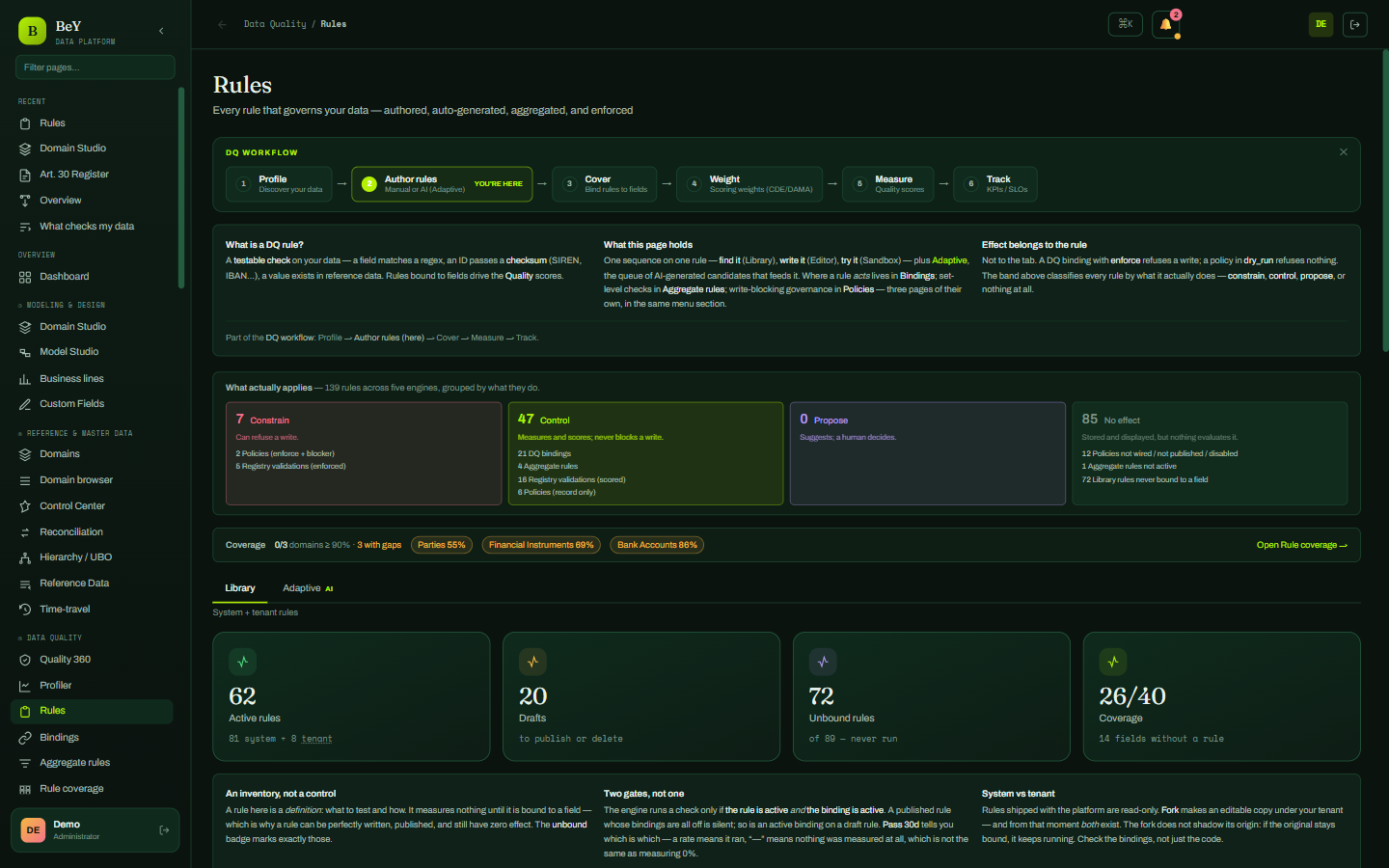
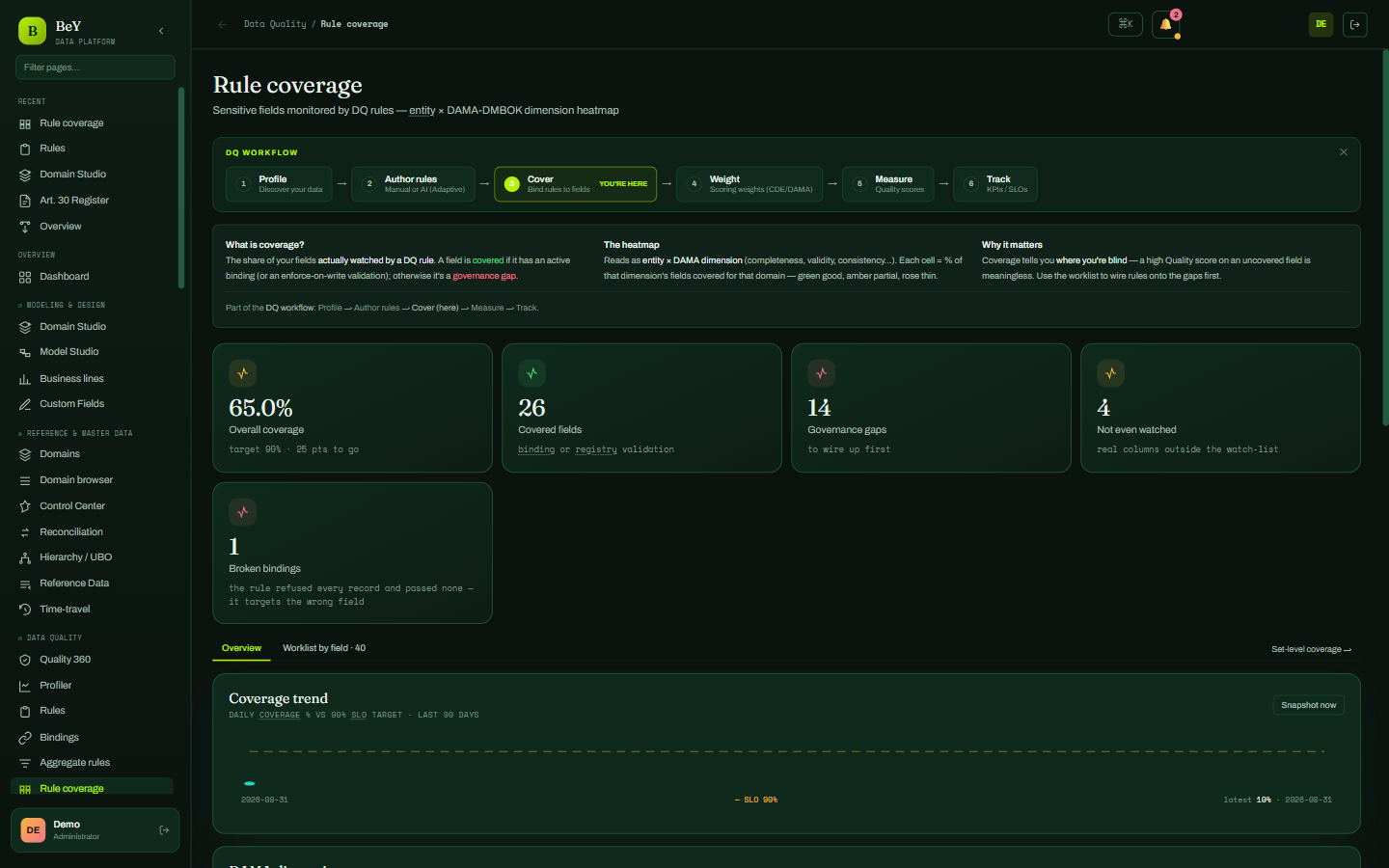
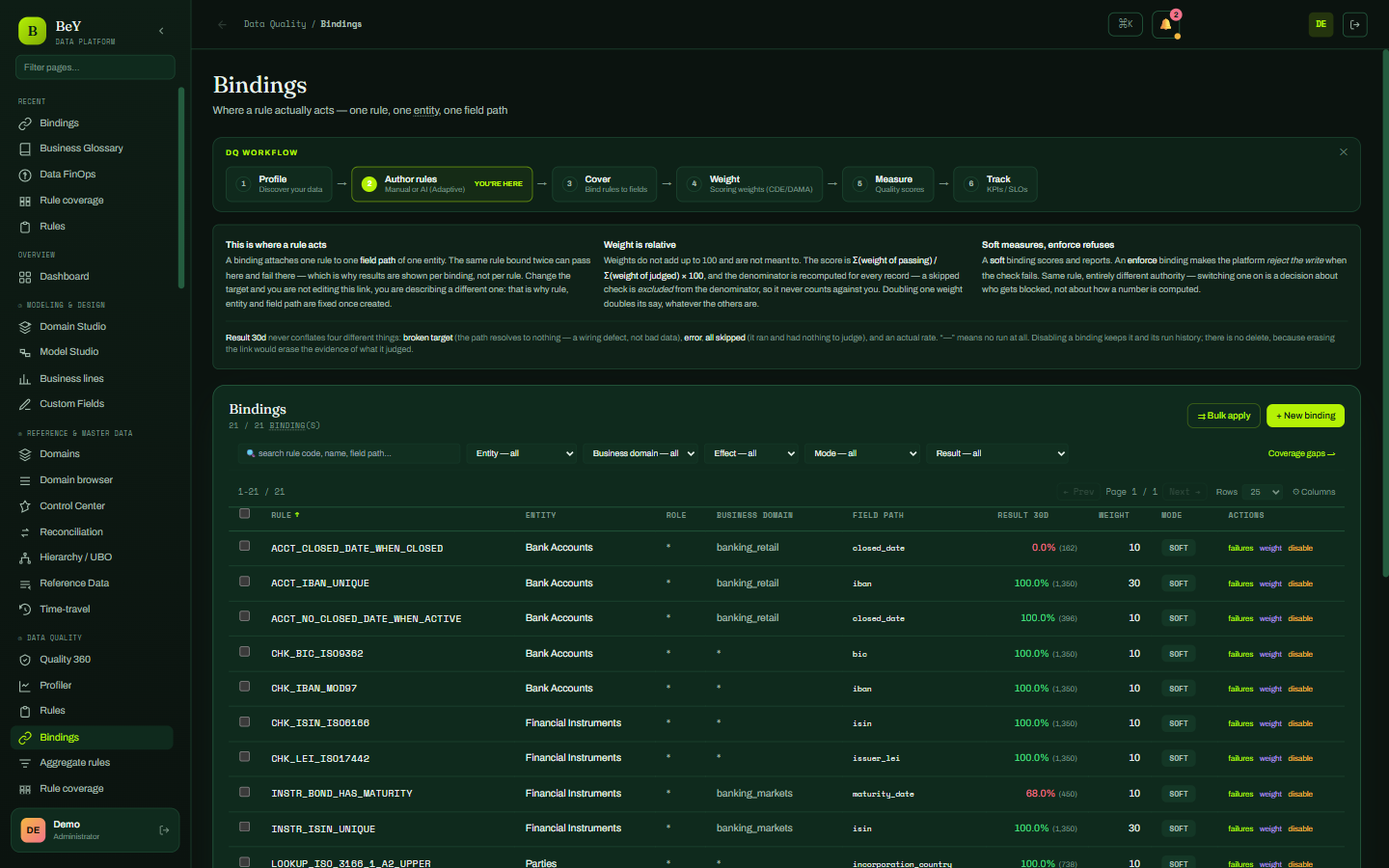
Rules are data, not code. Draft one, try it on real rows in a sandbox, publish it, bind it to a field — and let the platform tell you which fields no rule watches yet.
Overview
Most organisations know where their data is. Few can say which copy is right. BeY takes the data from the door to publication and keeps, at every step, a record of what was decided and why.
BeY does not copy your systems around. Your sources keep their data; what lives here is the one version everyone agreed on, rebuilt field by field, with the reason each value won.
A score is only as honest as its coverage. Every quality figure here arrives with the share of fields it actually watched — so 96% on half the fields never passes for 96%.
Flag a column as personal data and it shows up in the Article 30 register, under a retention rule, behind an access policy. Compliance follows the model, so it changes when the model does — not when someone remembers the workbook.
On a platform built to say where a number came from, a plausible answer nobody can check is the costliest mistake. So the assistant's tools only read, it cites figures it measured, and every action it suggests waits for a person to confirm.
Why one platform, and not three tools
Split across three tools, they contradict each other: the catalog does not know a rule just failed, the policy names an attribute the model has since renamed, and the audit asks for a state nobody can rebuild.
BeY holds them in one model. A quality rule points at the glossary attribute, which points at the physical column, which carries its classification, which triggers the policy. Change one and the others follow — or the gap is reported.
tenant_id — never a schema per customer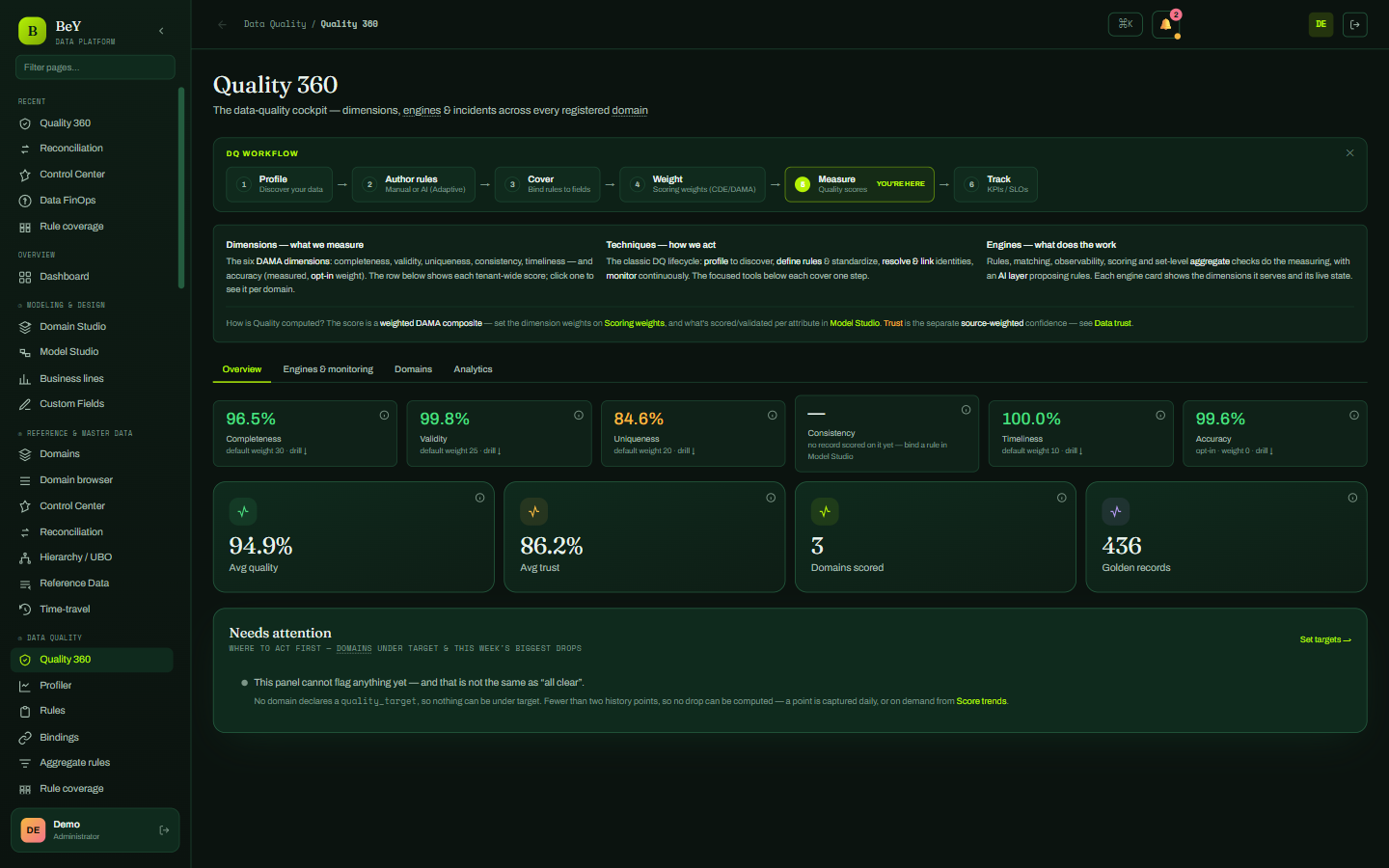
Product
The domain registry, engines driven by rules you never compile, an AI assistant that ranks duplicates without merging them, and groupings that lineage follows. Each one exists because doing it by hand stops scaling at the second domain — and each keeps a person in the decision.
Domain registry
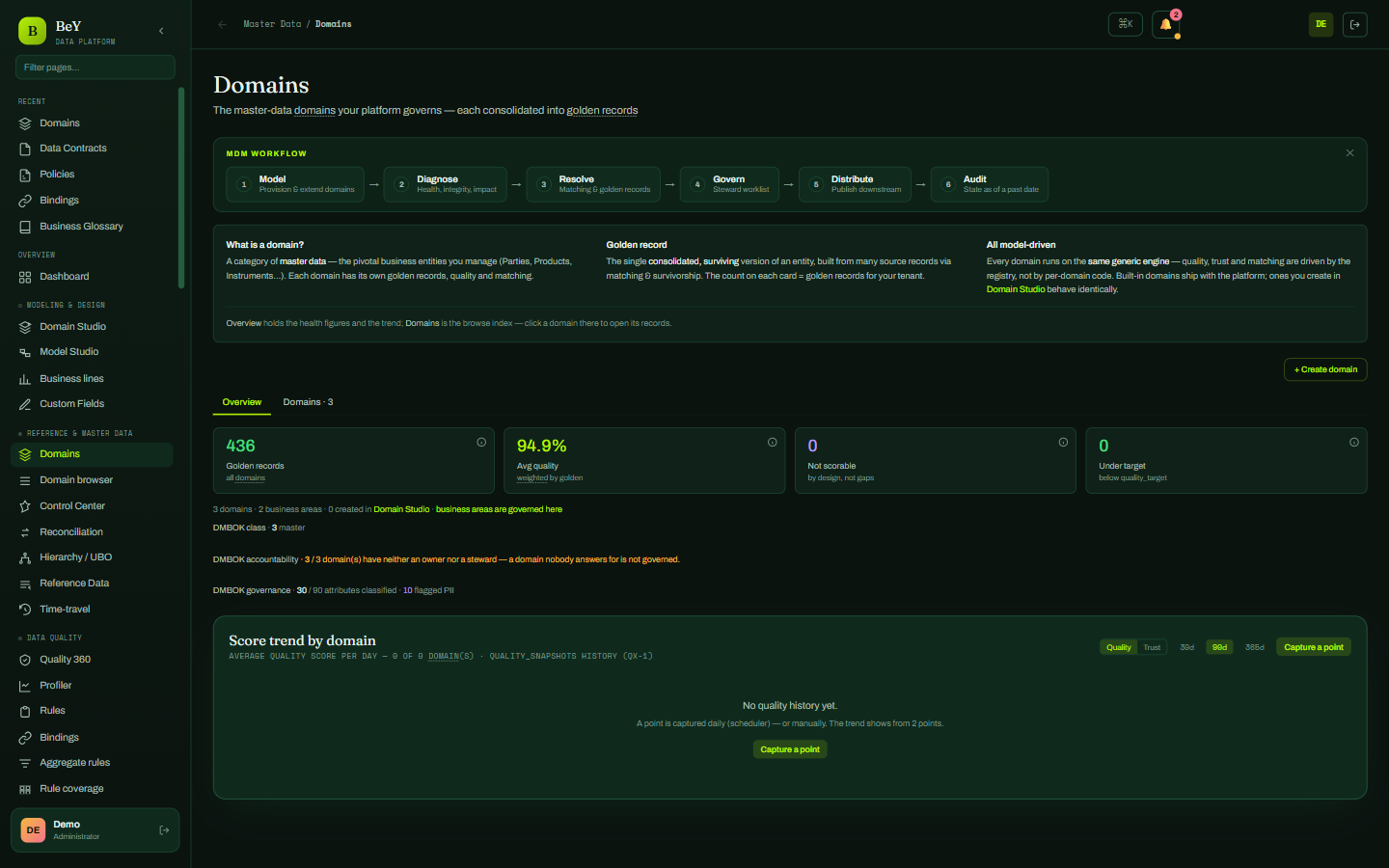
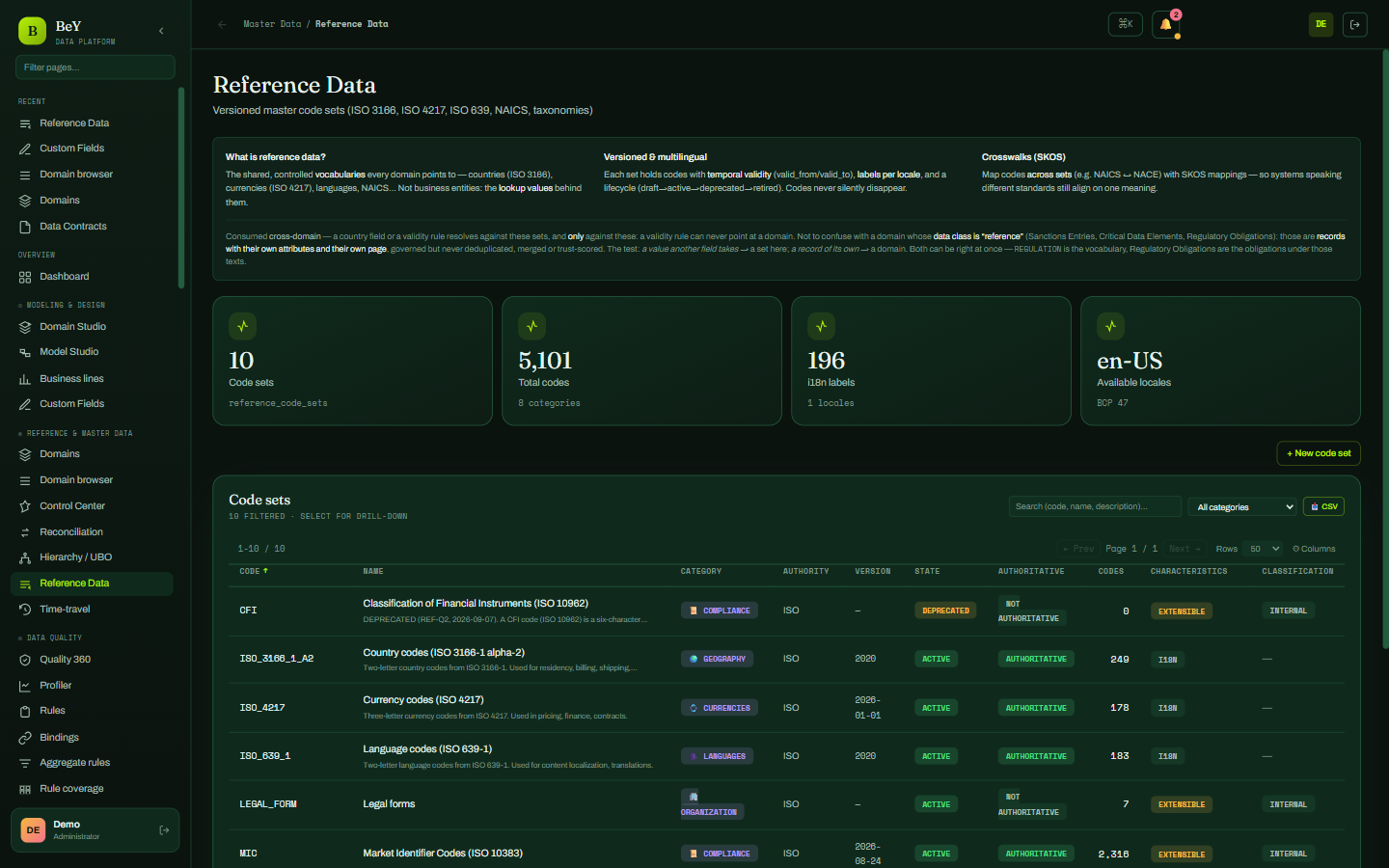
The registry is a library of ready-made domain templates — each one a schema plus a semantic manifest. Pick one and the engine applies it, provisions the domain and makes it appear in every hub at once. Or build one from a table you already have.
Dependencies are read, not guessed. A domain declares what it needs to exist, and the
engine works out the full chain and the order to install it — party before
anything that refers to a party, never the reverse. No table is ever created with
references pointing at nothing.
party and legal_entity are each required by ten other domainsThe gain. A new domain goes live in the time it takes to choose it, and it arrives with everything it depends on already standing.
Generic engines & rules
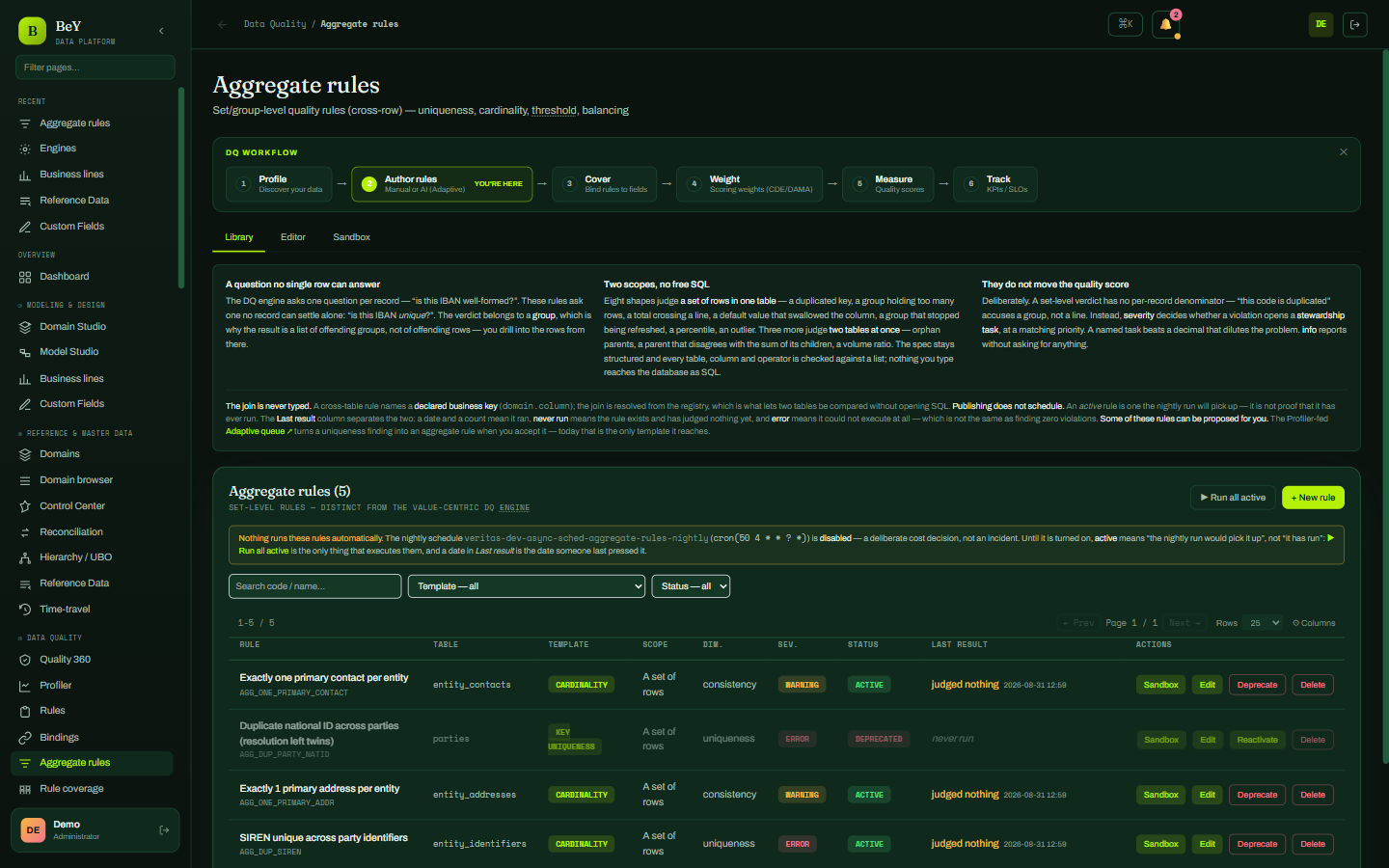
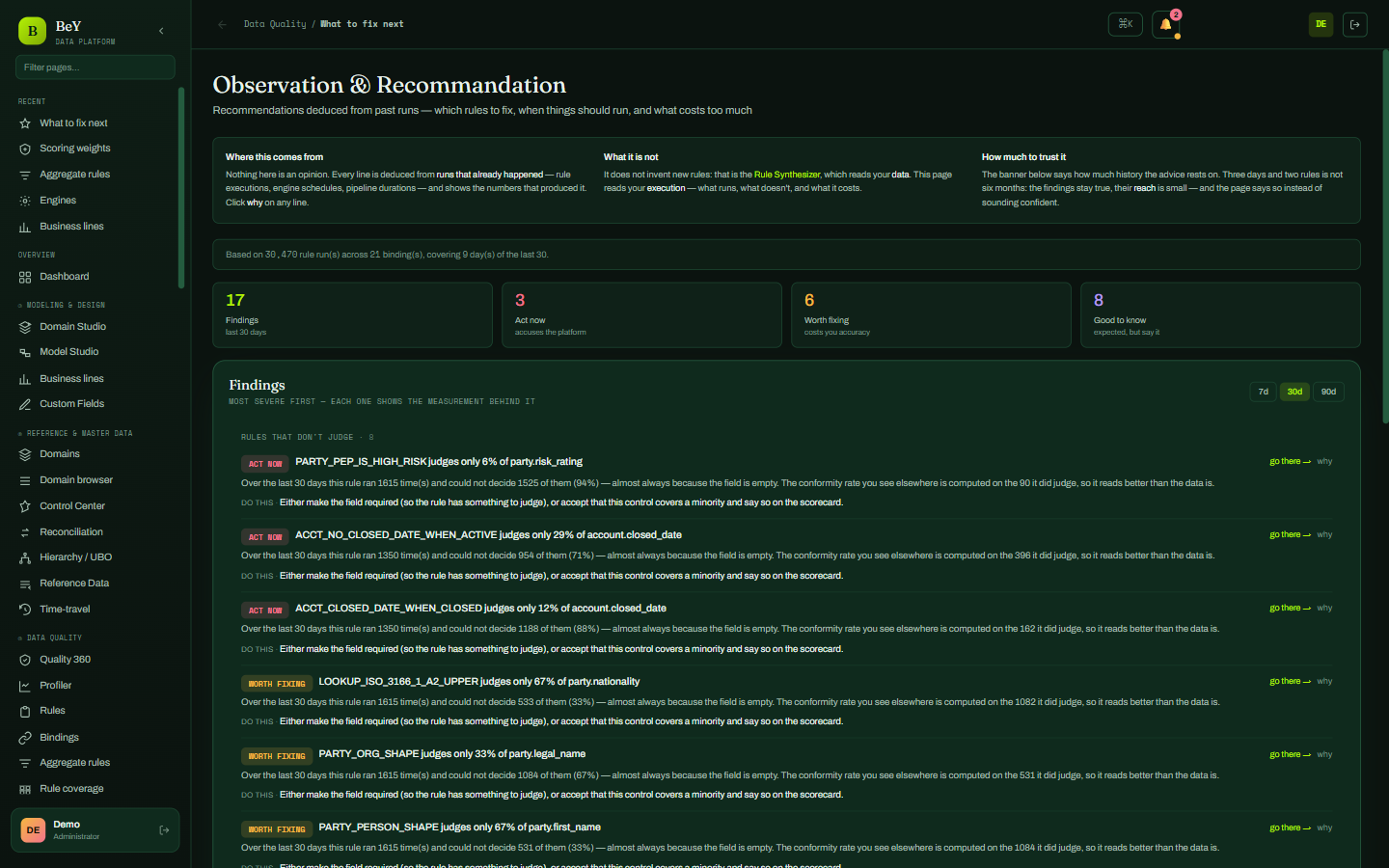
A rule is a record in a library — a type and its parameters — not a function somebody deploys. Binding it to data is a link: one rule can watch an attribute, a whole domain or a dataset, and the same library serves every engine.
Most of those links you never draw. The platform reads what a domain already declares
and binds the rules it implies. A freshly provisioned domain carried thirty-five semantic
attributes and zero active rules — while its own manifest already said
preferred_currency → ISO_4217. The information was there; it was simply
unread.
The gain. A steward changes what is controlled without waiting for a release — and can see at a glance which rules actually bite.
AI assistant · duplicate arbitration
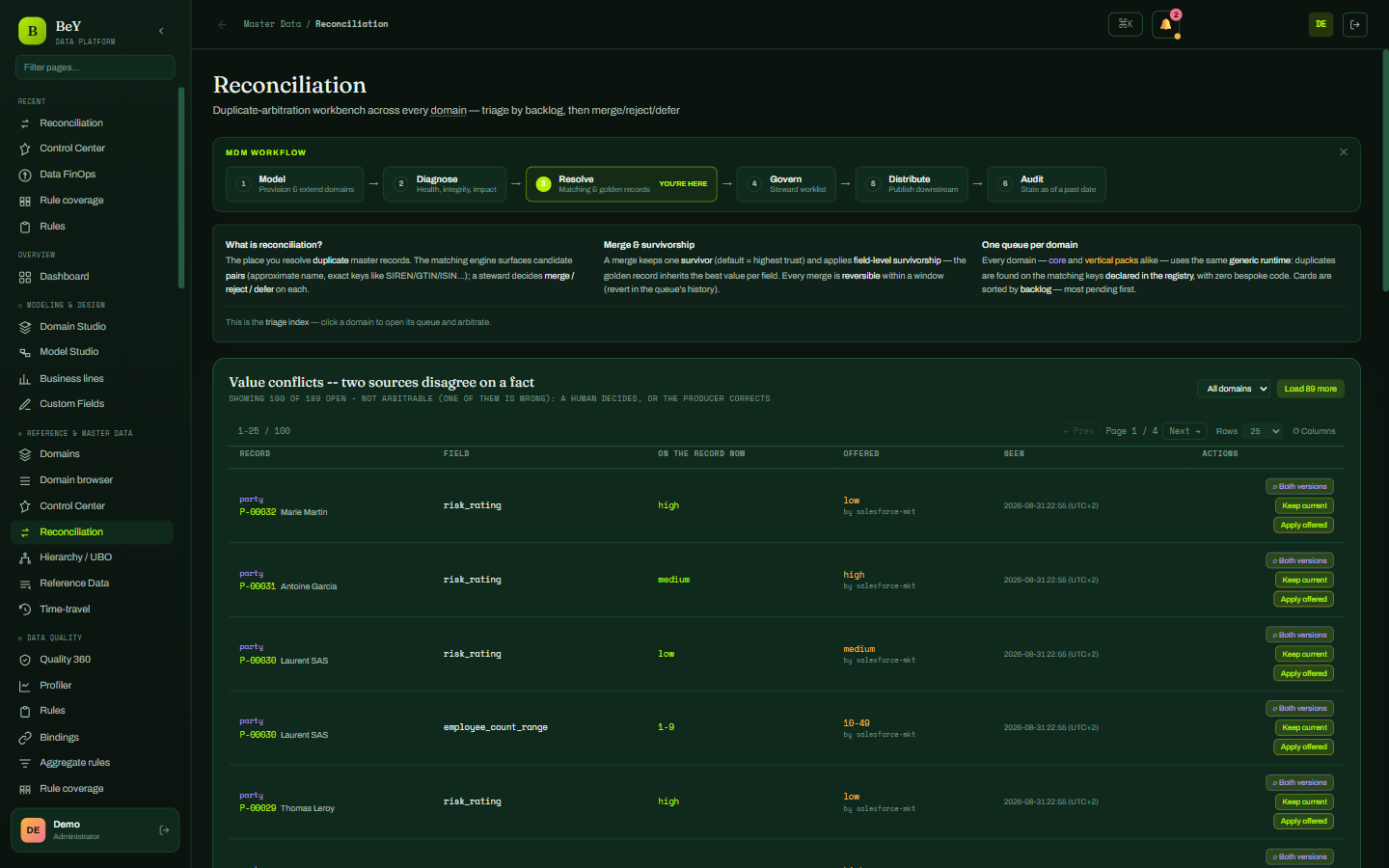
Two records that may be the same party — same name, different identifiers, one from SAP and one from Salesforce. The engine scores the pair, deterministically on identifiers and probabilistically on the rest, and puts it in the queue. It does not merge on its own: a score of 100 on the name alone is not proof they are the same person.
So the assistant does the reading. Asked what to look at first, it reads the queue and the domain's quality figures, groups the pairs that share a name, flags where one source outweighs the other, and says which pairs are safe and which need a second look. The steward then makes one of three moves — merge, reject, defer — and every one is journalled.
The gain. The queue drains at the speed of reading rather than investigating, and nobody loses the trace of who decided what, or why.
Groupings & lineage
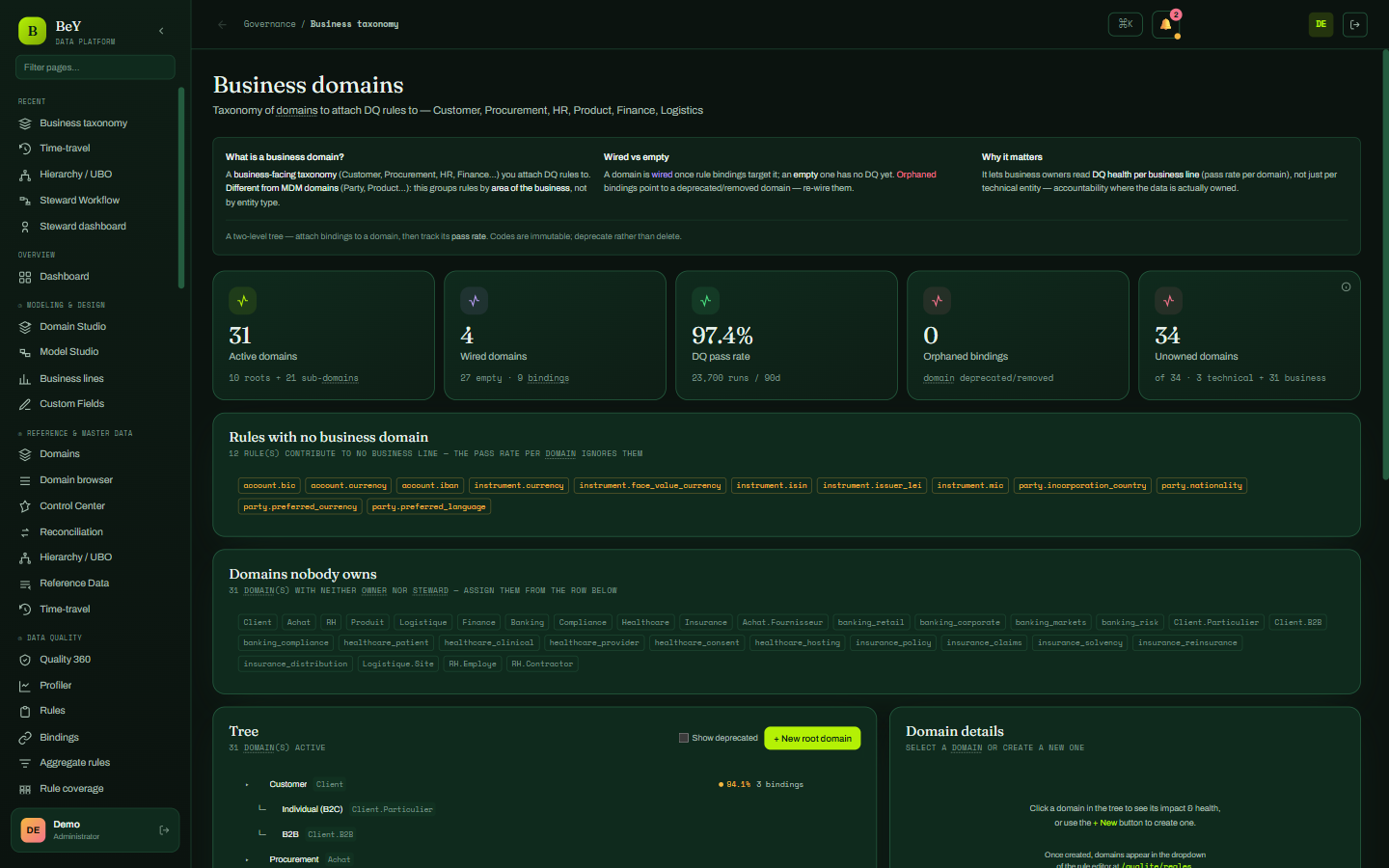
Packs, categories and business lines all say the same thing — these domains belong together — and in most platforms each says it in its own format, so none can answer for the others. BeY stores every grouping as the same edge between a group and a domain. A fifth kind of grouping costs no code at all.
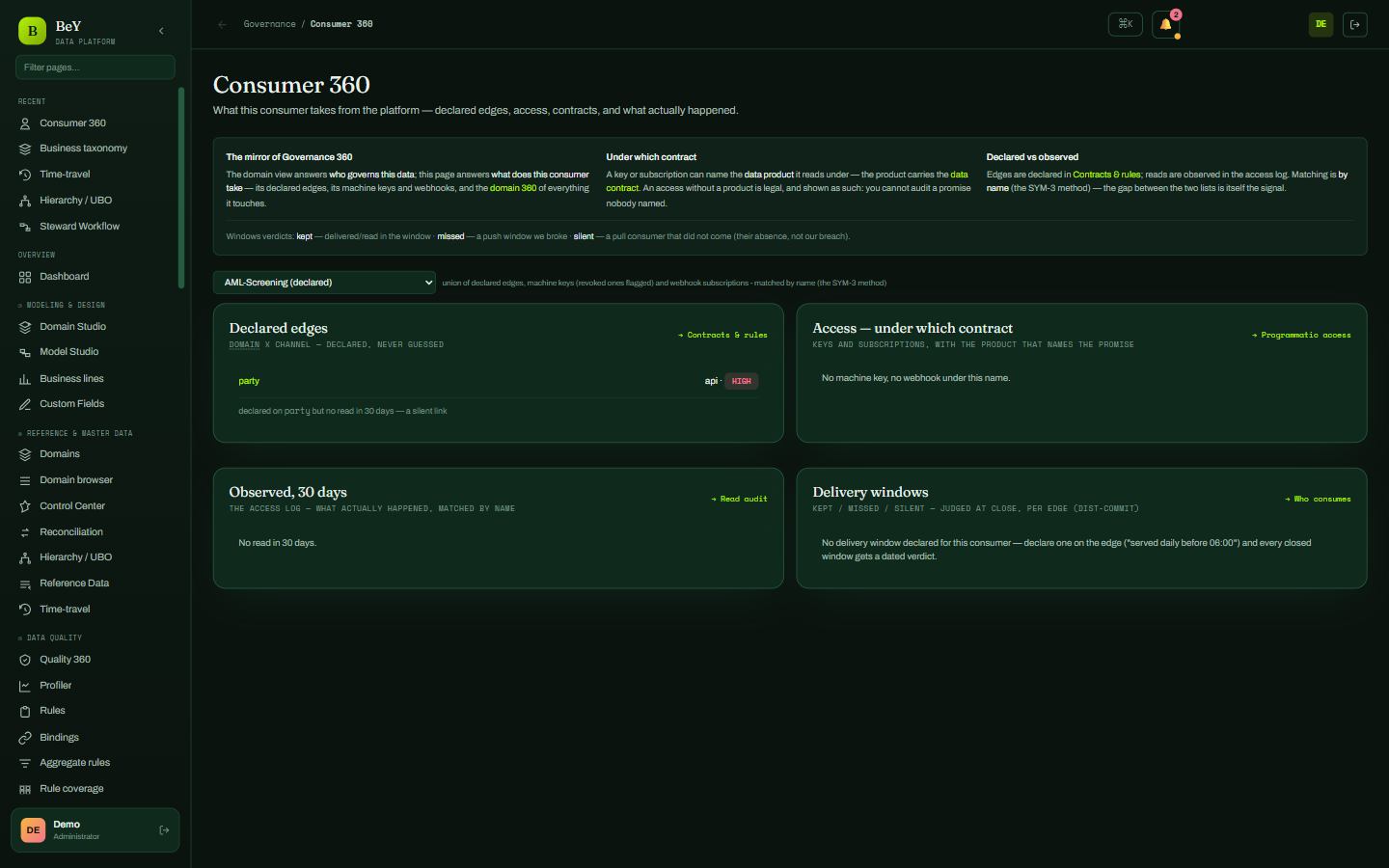
Lineage then reads along whichever grouping you care about: what a business line actually consumes, what a pack brings in, what a category spans. Impact analysis stops being a question you ask three tools.
The gain. “Who breaks if this stops?” gets an answer per business line, per pack or per category — from the same graph, without a second tool.
How it works
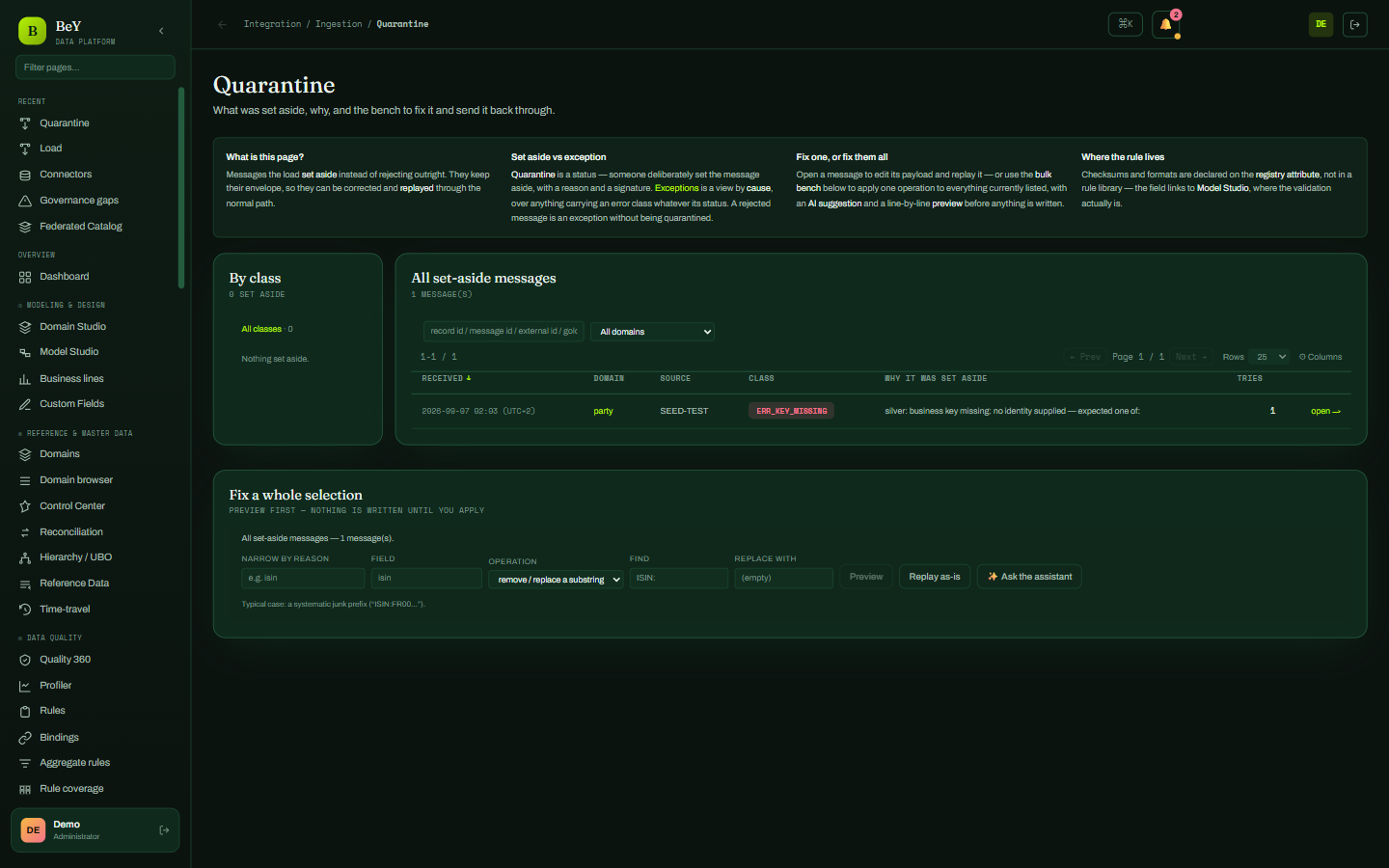
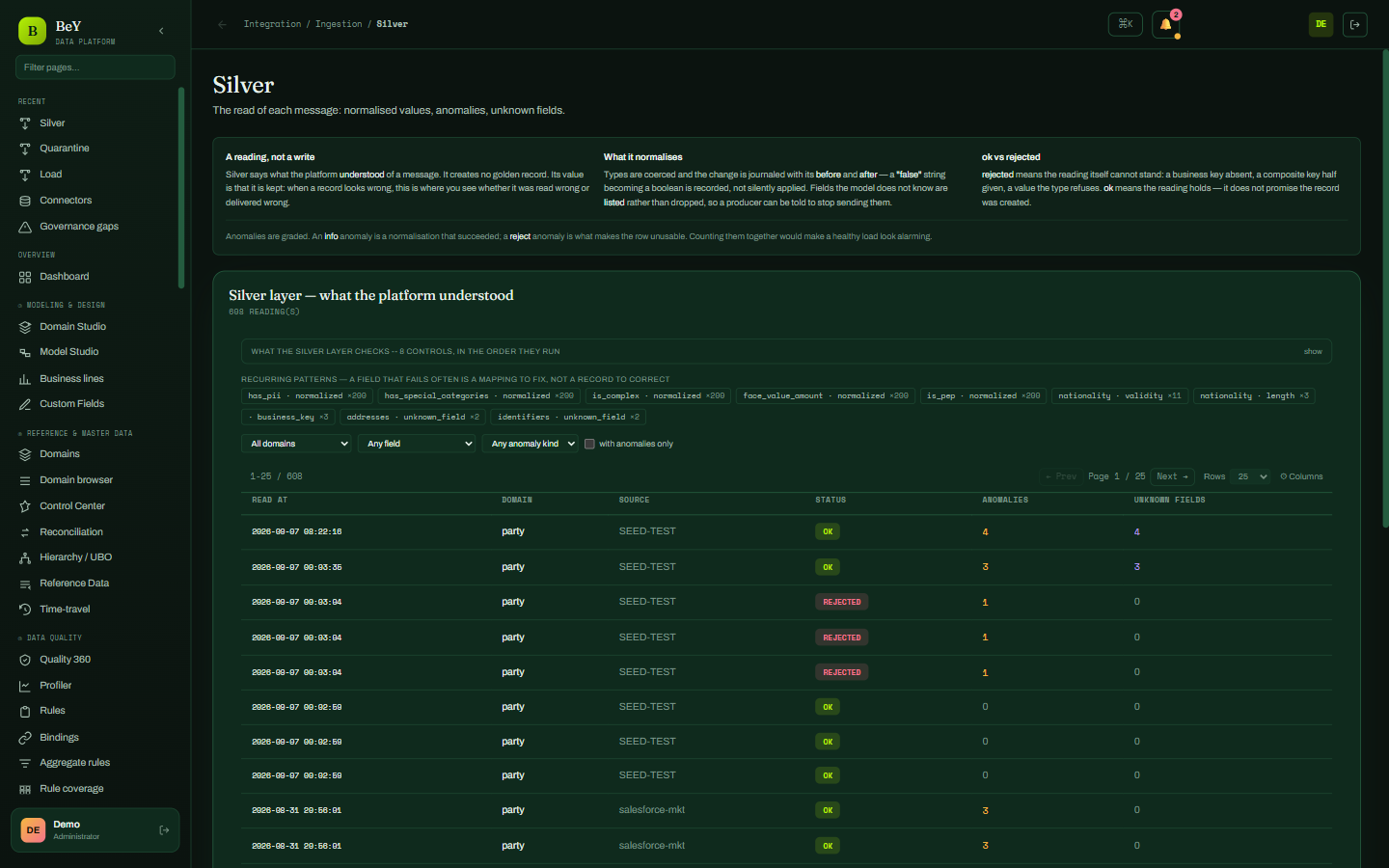
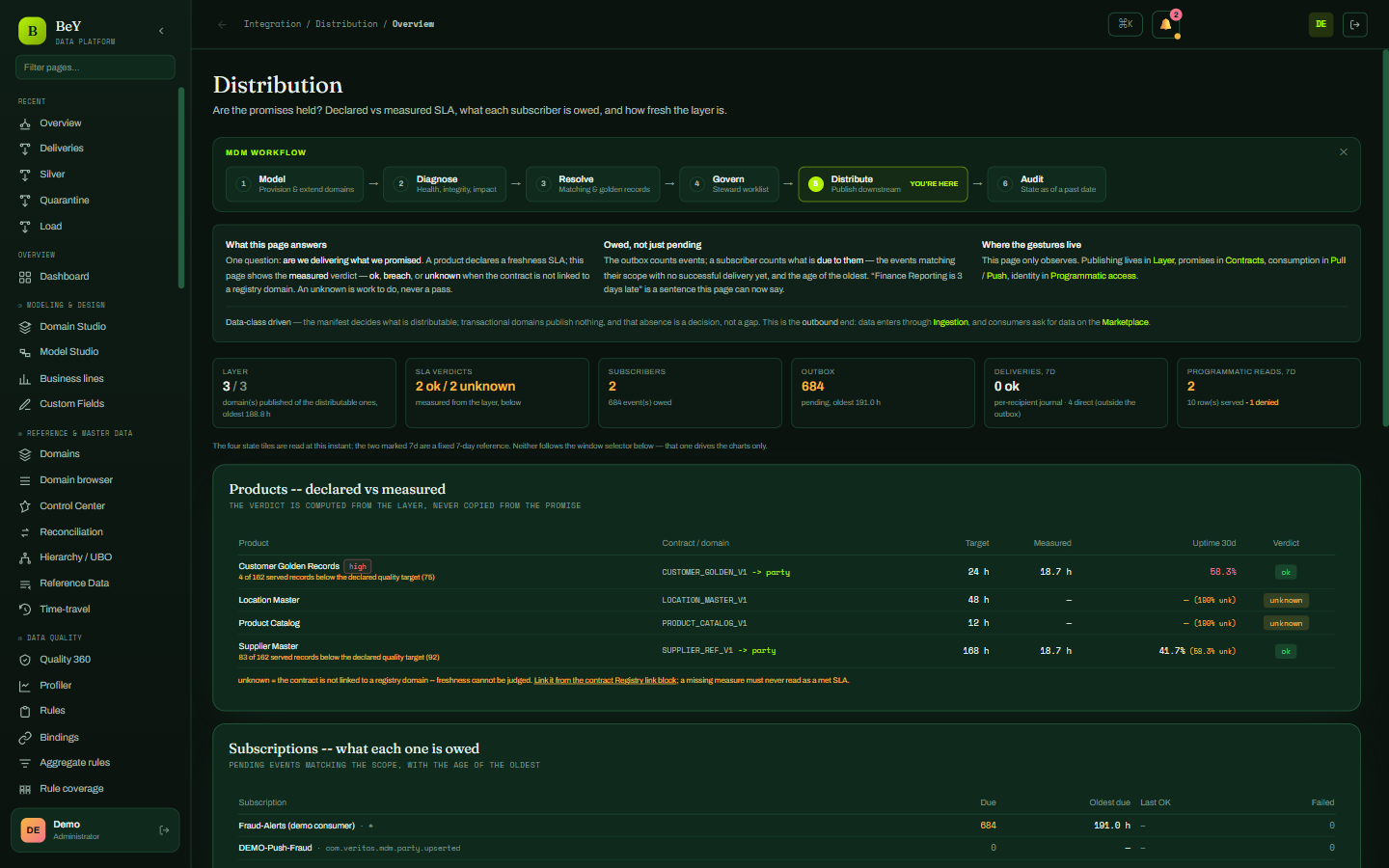
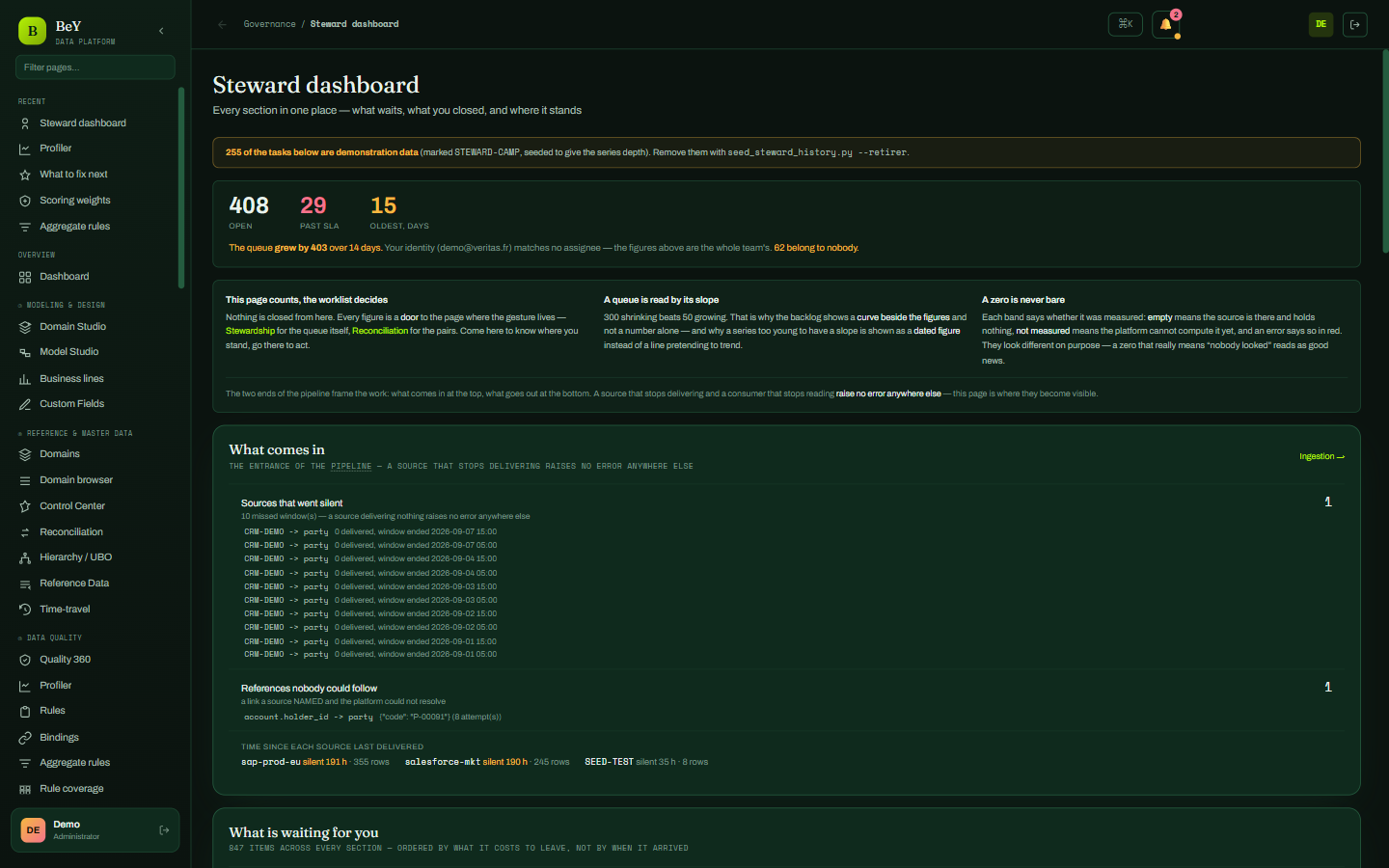
Each of those steps leaves a line in the journal — who, when, why. That journal is what lets Time-travel replay any record as it stood on a given date, with nothing rebuilt by hand.
The architecture page shows the six layers — one of them is the AI — what each one does, and how all of it gets built and shipped. Anything else, write to us.